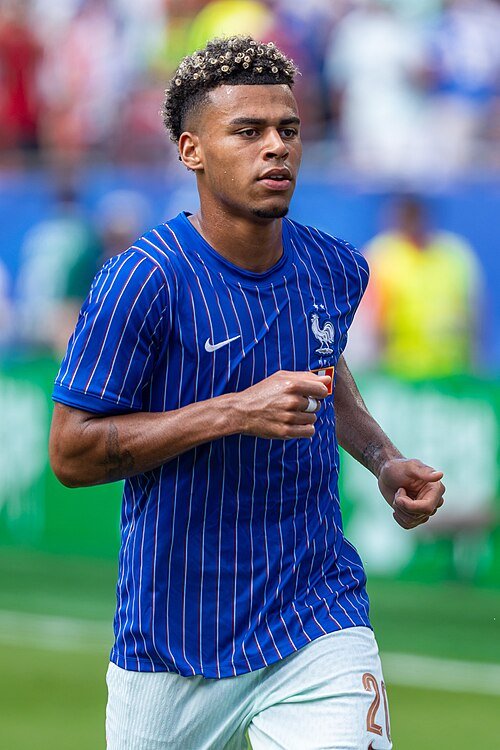
Désiré Doué: carrying threat into the final third
Doué is a useful case study in attacking versatility: watch how he carries the ball, combines with nearby teammates and changes the tempo of an attack rather than judging a performance by highlight moves alone.
Search Désiré Doué skills videos on YouTube ↗
What to watch
Track his starting position, first touch and the defender’s response. Notice when he tries to beat an opponent, when he protects possession and when he releases the ball to a teammate. His actions are most instructive when viewed in their tactical context.
Development and career context
Paris Saint-Germain’s official player profile says Doué was born in Angers, developed through Stade Rennais’ youth system, made his professional debut there in August 2022 and joined PSG in August 2024. The club describes him as an elusive and versatile attacking player. At the time of the source check for this profile, PSG’s biography also records his decisive role in the 2025 UEFA Champions League final and his recognition as UEFA Young Player of the Season. See the club profile for the complete, current account rather than relying on a static summary.
Those milestones explain why his name became prominent, but a skills article should add analysis rather than repeat a trophy list. Doué can be studied as a player who threatens defenders by carrying forward and by changing the picture with combinations. In wide or inside positions, a sharp first touch can put the defender on the back foot. A pause, feint or short pass can then create a route for himself or a teammate.
Technical themes
Ball carrying: A forward carry is valuable when it removes a defender or forces another opponent to help. The carrier should keep the ball protected, scan for the next line and avoid dribbling into a closed corridor.
Combination play: A pass is only half the action. Moving immediately after releasing the ball can create a return pass, draw a marker away or open a lane for another attacker.
Tempo changes: A short deceleration can make a defender step in; acceleration is effective when it follows a read of the opponent, not as a repeated sprint without purpose.
Training idea: 2-v-1 with a follow-up
Set a 15-by-12-metre area with two small target gates and a defender. The attacker receives from a teammate and chooses to carry through a gate or combine around the defender. After the first action, continue play for five seconds so the attacker must make a second decision. Begin with passive pressure, then increase resistance. Switch sides and roles; coach scanning, body shape and safe contact.
Reading a young player responsibly
One season, award or viral clip cannot establish a player’s future ceiling. Development depends on many factors, including opportunities, coaching, health and team role. This profile therefore focuses on observable actions and does not make transfer predictions or compare him as a guaranteed successor to another star.
For coaches, Doué’s film can prompt questions: Which touch moves him toward goal? When does he attract a second defender? Does the pass improve the team’s next action? A player who can answer those questions in practice is learning the decision behind the skill.
How to study an attacking sequence
Choose a complete possession rather than a short highlight. Start watching several seconds before Doué receives the ball. Where is he positioned in relation to the touchline, the nearest teammate and the defender who is likely to close him down? Is he checking toward the ball, holding a wide position, or moving into a pocket between lines? These details influence what the first touch can accomplish. A clip that starts at the moment of a successful dribble hides the preparation that made it possible.
Next, watch the approach of the defender. A defender who runs straight at the ball may be vulnerable to a change of direction; one who stays side-on may be protecting the inside lane. The attacker can then choose whether to accelerate, pause, shield the ball, pass or reset the attack. This is a useful way to discuss Doué’s versatility without claiming that every action has the same intention. The context changes from one possession to the next.
Receiving with more than one option
A versatile attacker benefits from arriving in a body position that keeps multiple actions available. When possible, turn the shoulders partly toward the field rather than receiving square to the sideline. An open stance can make it easier to see a teammate inside while still recognizing space down the line. In a match, the incoming pass may not make an ideal body shape possible, so players also need to practise receiving while moving, turning away from pressure and protecting the ball.
Coaches can set up a simple three-colour call. As the pass travels, a coach or teammate names a colour associated with a gate or support player. The receiver scans, takes a touch and chooses an action based on the defender. The cue should not replace reading the game; it merely encourages a quick look before contact. Progress by varying the pass speed and angle, then let the defender determine which space is available.
Good receiving is not always an attacking turn. Sometimes the safe action is to use the first touch to keep the ball away from pressure and pass backward. That can allow the team to change the point of attack. Rewarding this decision helps young players understand that composure and possession can be as purposeful as a direct run.
Progressing the 2-v-1 practice
The two-versus-one activity above can be adapted for different ages and experience levels. For beginners, widen the area and ask the defender to apply light pressure. The attacker can focus on looking up, controlling the ball and recognizing a clear route. For more experienced players, narrow the area or introduce a recovery defender who starts behind the play. The second defender encourages the attacker to decide quickly whether to combine or protect possession.
Keep the rounds short enough to maintain concentration and allow players to recover. Give the attacker a clear target—such as carrying through a gate, playing to a support player, or retaining the ball for five seconds—rather than asking for a particular trick. After each round, ask one question: “What did the defender give you?” Let the player explain the cue they noticed. This supports independent decisions instead of turning the coach into a remote controller of every touch.
Making the training transfer to a match
Isolated repetitions are useful for learning the movement, but players need to recognize when to use it in a game. Add a small-sided game with a neutral support player or a wide scoring zone. Award an extra point when a team creates a forward pass after drawing a defender, but keep ordinary goals available so players are not forced into a rehearsed pattern. The aim is to encourage recognition, not to manufacture a statistic that misrepresents performance.
Ask players to review one action after practice: What information did I see before receiving? What did I do when pressure arrived? What would I try next time? A short reflection is more actionable than a vague instruction to “be creative.” The same questions can be used to study professional footage, while remembering that a broadcast angle may not show all the options available to the player.
Physical preparation should be age-appropriate. A young player does not need to copy a professional’s repetitions, schedule or intensity. Use a safe surface, suitable footwear and a warm-up that fits the session. Increase difficulty gradually, stop if an athlete feels pain, and use qualified coaching guidance for individual needs.
What this profile can—and cannot—say
Doué’s official club biography is a source for career milestones, but one club account is not a complete independent analysis. It may emphasize achievements and current team information. For a balanced update, compare primary club and competition records, match footage and reputable reporting. Record the date on which time-sensitive details were checked. Avoid unsupported claims about personality, private life, medical history, future transfers or precise training routines.
The technical points in this article are learning prompts, not assertions that every listed quality defines every one of his performances. Viewers can test them against full-match sequences and disagree where the evidence suggests another interpretation. That approach makes the page more useful to coaches and readers than a list of superlatives.
Most importantly, a prospect profile is not a promise. Professional football careers are affected by selection, opportunity, health, coaching, personal circumstances and many other factors. Studying a talented player can inspire practice, but it cannot predict another young person’s future. Players should build their own strengths, enjoy the game and seek constructive feedback in an environment appropriate to their age.
Sources and image rights
Career context: Paris Saint-Germain official profile. This is independent educational commentary and is not affiliated with or endorsed by the player or club. Photo credit and reuse license are displayed below the image.