Lamine Yamal: reading the defender from wide
Yamal’s wide attacking play offers a practical study in receiving under attention, using changes of pace and deciding whether to go outside, come inside or combine.
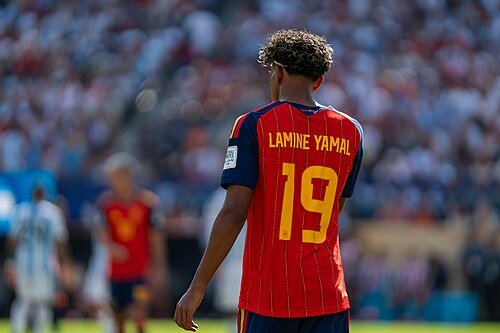
Search Lamine Yamal skills videos on YouTube ↗
What to watch
Follow the defender’s feet and body angle before judging the dribble. A winger’s choice depends on the support runner, available space and the position of the next defender—not just on which foot the player prefers.
Career context
Lamine Yamal is a Spanish forward developed at FC Barcelona. UEFA’s player profile lists his position as forward, his national team as Spain and his date of birth as 13 July 2007. His rapid rise has made him a familiar name, so this is a technical learning profile rather than a claim that he is an unknown prospect. Current appearances and statistics change by competition and season; check the live UEFA profile for up-to-date figures.
Skills in context
Wide players often receive with a defender close enough to influence the first touch. One option is to take the ball forward along the line; another is to bring it inside, where a passing angle or shooting lane may appear. A third option is to play back and move into a new space. The best choice depends on what teammates and opponents are doing.
Yamal is frequently studied for left-footed attacking actions from the right side, including close control and delivery. The useful lesson is not simply “cut inside.” The attacker should first scan for the fullback, covering defender, central teammate and the space behind. A deceptive body shape can persuade the defender to protect one route, but the next touch must still serve the attack.
Training idea: three exits from the wing
Mark a 12-metre channel along a touchline with three end zones: outside lane, inside gate and a support player behind. The winger receives from a server while a defender approaches. The attacker chooses one of the three exits based on the defender’s position. Award the point for a controlled action into the chosen zone, not for a trick. Begin with a defender who shades one side, then let the defender choose freely. Repeat on both wings.
Build the habits, not a copy
Young players can learn from Yamal’s composure while remembering that individual development differs. Age, physical growth, coaching and match role all shape what is appropriate. Keep practice varied and balanced; include decisions, passing and defensive transitions instead of endless isolated dribbling. Coaches should praise a sensible pass or retained possession as much as a successful one-versus-one.
When reviewing footage, pause before the first touch and ask: what options are open? Pause after the touch and ask: which defender has reacted? This simple routine builds game understanding and helps players recognize why an action worked. It also reduces the risk of teaching a highlight as a guaranteed recipe.
Read the whole picture before the duel
A one-versus-one is rarely just two players isolated on a touchline. The winger has to account for the fullback, a covering defender, a teammate making an overlapping run, a midfielder offering a short pass and the goalkeeper’s position if the move reaches the box. Yamal’s actions are useful to study because they prompt questions about the relationships around the ball. Before deciding to dribble, a player can scan to learn whether the inside channel is occupied or whether a teammate is ready to receive.
The defender’s distance changes the available action. If the defender is several steps away, carrying forward may gain ground. If the defender is close and balanced, a quick pass or protective first touch may be safer. If the defender is showing the attacker toward the sideline, the inside route may be crowded by a second opponent. There is no universally correct choice; the skill is noticing the cue early enough to act with control.
When studying footage, review the moments when the attacker chooses not to take on the defender. A pass back can help the team keep the ball, invite the opponent forward and create room elsewhere. It should not automatically be judged as timid. The next movement matters: a winger who passes and moves can receive again or pull a marker away from the centre.
First touch and body shape on the wing
Receiving near the touchline gives an attacker less room on one side, so body shape becomes important. If the player can see the defender and the inside of the pitch, the first touch can protect the ball while keeping a forward option visible. A touch too close to the line may leave no exit; a touch too far ahead can invite the defender to win possession. The ideal distance depends on the incoming pass, speed, pressure and the player's balance.
Practise receiving from different angles rather than repeating a single feed. A teammate can pass firmly along the line, roll the ball from inside or serve it slightly behind the receiver. Ask the player to scan before the ball arrives and adjust their feet to face the field. This variation prepares players for actual matches, where the pass is rarely delivered exactly as expected.
A first touch can also be a deliberate disguise. The player may shape as if to move inside, then take the ball down the line if the fullback closes the centre. The feint is only useful if it is followed by a controlled action. Young players should learn the movement at a slow speed, then add a defender when they can maintain balance and awareness.
Training progression: from technique to game decisions
The three-exit drill can be developed in stages. First, let the attacker receive without a defender and practise taking the ball through each gate with both feet. Second, add a passive defender who protects one route. Third, allow the defender to choose a position freely. At each stage, the attacker should explain what they observed and why they selected an exit. This reflection helps distinguish a deliberate action from a move performed by habit.
Use small-sided games to test transfer. Mark a wide lane and give a team a bonus point when a player uses a purposeful combination to enter it or creates a chance from it. Keep normal scoring too. If every reward depends on dribbling, players may force the duel even when a pass is clearly better. If every reward depends on passing, they may avoid attacking space. A balanced game lets the player read the real situation.
Measure learning without chasing highlight statistics
After practice, players can record a few simple observations: Did I look before receiving? Did my first touch leave more than one option? Did I choose a dribble, pass or hold based on the defender? Did I support the next action after releasing the ball? These questions measure habits that are within the player's control. They do not require public rankings or comparisons between children.
Coaches should give feedback on a specific behavior. “You checked your shoulder before the pass and received on the back foot” tells the player what to repeat. “You are the next superstar” is neither useful technical feedback nor a responsible promise. Young athletes develop at different rates, and public attention can create pressure that is unhelpful to their learning.
Respecting age and development
Yamal is a young professional, and youth readers should not be expected to copy professional match loads or schedules. Training should be appropriate to a player's age, experience and physical readiness. Keep sessions varied, include rest, and ask a qualified coach or medical professional about individual concerns. Skill development should support enjoyment, confidence and safe participation rather than an unrealistic attempt to accelerate a career.
Study the decision-making, not the private life or unverified stories around a famous teenager. Avoid speculation about contracts, health or personal circumstances. A public player profile can be informative while maintaining a clear boundary between football analysis and private information.
Why this is a study profile, not a prediction
UEFA’s player page is useful for basic competition information and current statistics, but those figures vary by competition and date. A match count is not a complete measure of contribution, and a statistic should always identify the competition and season it covers. If this page is updated, check the source date and use the official competition record rather than copying an undated number.
Yamal’s technical actions can inspire young wingers, but every player has different physical attributes, team responsibilities and learning needs. The transferable ideas are broad: scan early, receive with awareness, recognize the defender’s shape, and choose the next action that benefits the team. A player can apply those ideas without adopting another athlete’s exact position, foot preference or style.
Sources and image rights
Player details and current competition data: UEFA official player profile. This independent skills analysis is not affiliated with or endorsed by the player or club. Photo credit and reuse license are displayed below the image.