Yassir Zabiri: finding the moment to finish
A striker’s work begins before the shot. Zabiri’s rise through youth international football gives players a useful prompt to study positioning, timing and composure in the penalty area.
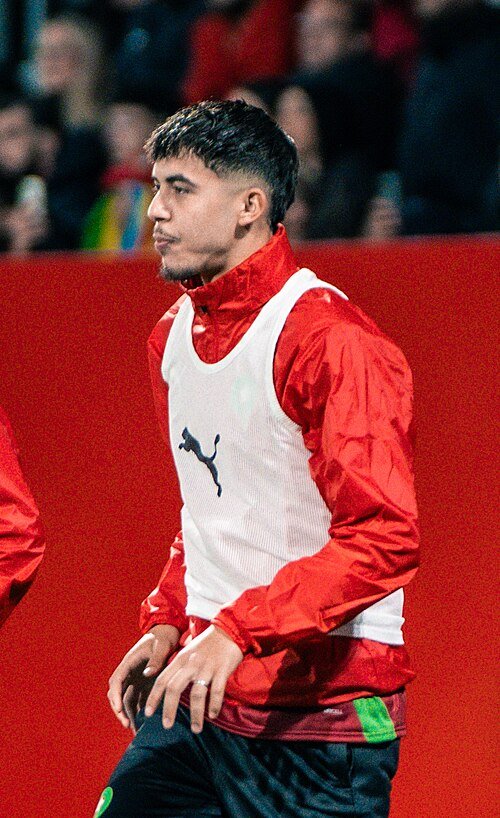
Search Yassir Zabiri skills videos on YouTube ↗
What to watch
Watch the forward before the pass: where is he positioned relative to the last defender, what run does he make, and how does he adjust when the delivery changes?
Morocco’s U-20 World Cup campaign
Yassir Zabiri was part of Morocco’s successful campaign at the 2025 FIFA U-20 World Cup. He attracted attention for his goal threat and was reported as the tournament’s Golden Boot winner. Because tournament awards and statistics should be cited precisely, check FIFA’s official final award record when publishing or updating this page. The competition is a useful dated reference point, not a statement about his present club status or future ceiling.
Young forwards are often evaluated only by goals, but a fuller review looks at how chances are created. A forward may make a run that opens space for another attacker, occupy a centre-back, press a defender into a rushed clearance or hold the ball so teammates can advance. Those contributions help explain why a team trusts a player in different match situations.
Reading space and finishing choices
In the box, a small adjustment can matter. A striker might hold a run to stay onside, move across a defender’s shoulder or change direction to reach a cross. Once the ball arrives, the player must quickly choose a surface and target. A composed finish is usually connected to balance and preparation, not simply power.
Coaches can use Zabiri’s tournament performances to prompt observation: does he attack the near post, wait for a cutback, or move into the space between defenders? The answer can differ from one attack to another. Good analysis connects the movement to the delivery and the defensive shape instead of assigning a fixed style to a player.
Training idea: time the run
Set up a server near the wing, a forward in the middle and a defender between the forward and goal. Place three small target zones across the goal area. The forward begins level with the defender, checks away, then attacks the space as the server prepares to cross or pass back. Rotate the service and ask the forward to choose a target zone based on the ball’s path. Keep heading work age-appropriate and follow current safety guidance.
Build a complete striker
Finishing practice is more valuable when it includes a decision. Vary the pass, add a defender, and ask the striker to choose whether to shoot, take a touch or lay the ball off. Track good decisions as well as goals. A missed shot after a good choice can still be a productive repetition; a goal from a poor decision is not always repeatable.
There is no single route from youth tournament success to a senior career. Selection, minutes, coaching, health and personal circumstances all matter. Readers should treat scouting language as opinion and monitor reliable official updates rather than assuming that a young player’s next move is known.
Study the run before the finish
When reviewing a striker, start before the ball reaches the wide player or midfielder who may deliver it. Look at Zabiri’s starting position relative to the defenders. Is he staying close to the centre-back, drifting into a gap, or moving toward the near post? Does he make a short movement away before accelerating forward? These details can create separation or make it more difficult for the defender to track the run.
Next, watch the timing. A forward who moves too early can arrive before the pass is possible or risk an offside position. A run that begins too late may allow the defender to block the route. The attacker has to read the ball carrier’s body shape and the likely delivery. This is why a good run is a collaboration between the passer and the forward rather than a sprint made in isolation.
After the shot, continue watching. Does the striker follow in case of a rebound? Does he recover to help press when possession is lost? Does he communicate with teammates about the next phase? These actions do not always appear in goal compilations, but they form part of a forward’s work across a full match.
Finishing is a decision under pressure
When a chance arrives, the player must decide whether to shoot first time, take a touch, pass across goal or protect the ball. The choice depends on the distance to the goalkeeper, angle, defender’s position and teammate movement. Powerful contact is not always best. A controlled finish toward an open corner may be more effective than striking as hard as possible from poor balance.
Players can practise this by using varied service. A coach or teammate can roll the ball along the ground, pass it slightly behind the forward, or send a cutback toward the edge of the box. The attacker should adjust their feet and body rather than forcing the same finishing technique every time. Begin without pressure, then add a passive defender, then a live defender only when the group is ready.
Keep the instruction focused on quality. A session does not need dozens of rushed shots to be productive. A smaller number of repetitions with time to reset, observe and receive feedback can be more useful. Players should work at a safe pace, use appropriate footwear and follow guidance from their coach.
Training idea: build a complete scoring action
Extend the timing exercise into a three-part sequence. The forward starts by checking toward the ball, then spins into a marked channel after a teammate receives. The server chooses between a pass to feet, a through ball or a cutback. The forward must adapt the run and then decide how to finish or combine with a second attacker. The defender begins passively and becomes active only after the players understand the routes.
Make the practice age-appropriate. If the group is young or inexperienced, use a larger space, a slower pass and no heading requirement. If aerial service is included, follow current safety guidance and qualified coaching recommendations. Do not ask children to copy the physical workload of professional adults.
Understand the tournament achievement
Morocco’s 2025 U-20 World Cup victory was a team achievement and a major moment for the players involved. Zabiri’s goal threat and his recognition as a leading scorer made him a prominent individual in the tournament conversation. When citing an award, use the official competition record and clarify the context: award names, shared totals and tie-break rules can matter. Do not repeat a number without identifying the source and competition.
A tournament performance is a snapshot, not a full career report. A player’s role in a later club season might differ from his national-team role. Minutes, formation, teammates and opposition change. Therefore, a current profile should distinguish what happened in Chile in 2025 from what the player is doing now. Check the club or federation profile before stating a current team, injury status or statistics.
It is also important to credit the teammates who create chances. A goal may depend on a midfielder’s pass, a winger’s run or a defender winning possession high up the pitch. Individual profiles can explain how a striker contributes while recognizing the collective structure around him.
Useful review questions for a striker
After watching a match sequence, ask: Did the forward scan before moving? Did the run stretch the defence or enter space already occupied by a teammate? Was the timing connected to the passer’s preparation? Once the ball arrived, did the first touch create a better angle? If the shot was blocked, did the forward make a second effort or help the team reorganize?
For players, use a notebook or simple post-session reflection to record one successful decision and one situation to practise. Keep the focus on learning rather than comparison with professional numbers. Progress can include better positioning, clearer communication or a more composed choice, even if a particular shot does not result in a goal.
Responsible coverage of a young forward
Scouting language should stay cautious. No writer can promise a particular ceiling or guarantee a transfer based on a few matches. Avoid unconfirmed rumors, personal speculation and unsupported claims about training habits. Use clear attribution for historical facts and label tactical interpretations as analysis. Readers deserve a distinction between verified record and opinion.
Images need the same care. A player portrait is protected content unless the rights holder grants permission or a license allows the use. A search result, club website image or social post is not automatically reusable. This draft uses no player photo. If one is added later, keep a record of the license, follow attribution conditions and avoid implying sponsorship or endorsement.
Zabiri’s story can be followed through official match and club updates. Meanwhile, the transferable lesson for aspiring strikers is straightforward: prepare the run, stay aware of defenders and teammates, and make the finish a response to the situation rather than a preselected action.
Sources and image rights
Tournament context: FIFA U-20 World Cup Chile 2025. Verify the Golden Boot detail and any current club or statistics from the official FIFA record and the player’s club or federation before republication. Photo credit and reuse license are displayed below the image.