Soccer Position Numbers Explained with a Simple Field Diagram
Soccer position numbers are a shorthand for talking about roles. When a coach mentions a “6,” “8,” “9,” or “10,” they may mean a type of player or a place in the team shape, not the number printed on that player’s shirt. Understanding the difference makes tactical conversations much easier.
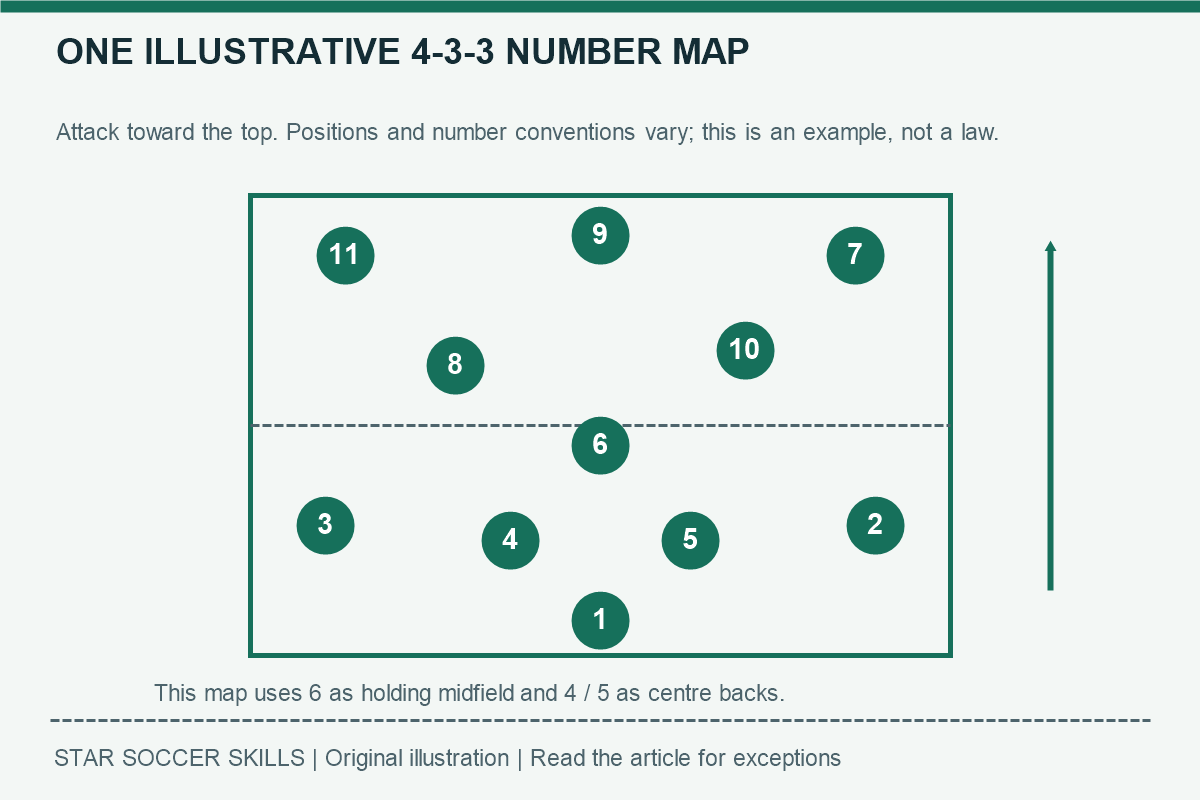
There is no single worldwide numbering map that every country, formation, and coach uses. The field diagram below shows one illustrative 4-3-3 convention. It is an example, not an IFAB requirement or a claim that every team must line up this way. For the underlying ideas of space and support, start with our positioning and tactics lesson.
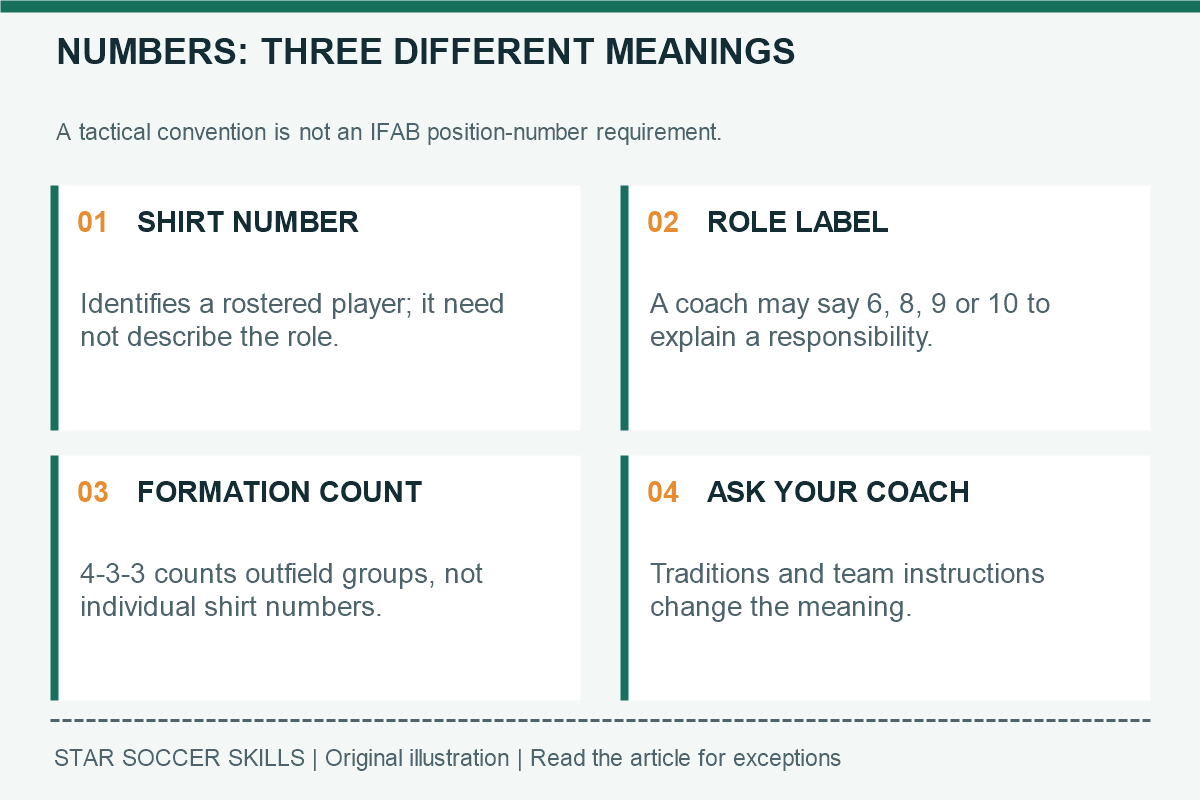
Three different meanings of a soccer number
A shirt number identifies a player on a roster and during a match. Competition rules govern the permitted numbers. A winger wearing 22 does not become a different position simply because the shirt lacks a traditional winger number.
A position-number convention is a shared tactical vocabulary. A coach might call a holding midfielder “the 6” even if that player wears 14. The convention helps explain the role without naming a particular player.
A formation number, such as 4-3-3, counts groups of outfield players in a simplified shape. It is not a sequence of shirt numbers, and it normally leaves the goalkeeper out of the three-number description.
An illustrative 1-to-11 map
The following example uses a back four, a holding midfielder, two other central midfield roles, and three attackers. Some traditions place 4, 5, and 6 differently; others use different labels for the midfielders. Ask the coach what the number means in that team’s system.
| Number | Role in this example | Important qualification |
|---|---|---|
| 1 | Goalkeeper | Other shirt numbers can also be used by keepers |
| 2 | Right back | Side is from the team’s attacking perspective |
| 3 | Left back | May play wider or narrower depending on the plan |
| 4 and 5 | Centre backs | These numbers vary notably between traditions |
| 6 | Holding or defensive midfielder | Can describe a role, not an actual shirt |
| 8 | Connecting central midfielder | Often associated with two-way midfield play |
| 10 | More advanced creative midfielder | Not present as a separate slot in every shape |
| 7 | Right-sided attacker | Can move inside rather than staying on the line |
| 11 | Left-sided attacker | Responsibility depends on team instructions |
| 9 | Central striker | Movement and link play vary between strikers |
What does playing as a 6 mean?
A “6” commonly refers to a midfielder positioned in front of the centre backs. In possession, the player may offer a safe passing option and help connect one side of the team to the other. Without the ball, the role may include protecting central space and tracking threats between the lines.
That does not mean standing on one spot or making only backward passes. The useful position changes with the ball, teammates, opponents, and the coach’s instructions. Two teams can both use a player they call a 6 while asking that player to behave differently.
What does an 8 do?
An “8” often describes a central midfielder connecting defensive and attacking actions. People may use “box-to-box” for one version of the role, but not every 8 makes the same forward runs or covers the same areas.
In this diagram, the 8 starts ahead of the holding midfielder and to one side. During play, the player might move wide to support, receive between opponents, or recover toward their own goal. The number helps start the explanation; it does not finish it.
What is a number 10?
A “10” often means an advanced creative player who looks to receive between midfield and defense, connect with attackers, or create chances. That player might operate centrally in a 4-2-3-1, in a different midfield arrangement, or as a role that changes when the team loses the ball.
Not every team uses a dedicated 10, and wearing the shirt does not guarantee those duties. A beginner should ask “Where should I support when we have the ball?” rather than copy a professional simply because they share a number.
The 9, false 9, and wide attackers
A “9” generally points to a central attacking reference. One striker may stay high to threaten space behind defenders; another may drop toward midfield to link play. The phrase “false 9” usually describes a central forward who drops away from the traditional highest position to affect the defense and create space.
Numbers 7 and 11 often suggest wide attacking roles, but width is not their only task. They may move inside, help press, or recover with the team. Do not treat the diagram as eleven permanent parking spaces.
Why formation changes can confuse the map
A 4-4-2 has two forwards and a different midfield picture from this 4-3-3 example. A 3-5-2 may use wing-backs rather than a conventional pair of fullbacks. The same role labels cannot always be transferred one-for-one.
Young players in smaller formats also do not need an eleven-player numbering system imposed on them. Learn direction, support, and safe spacing first. Our small-sided games lesson shows how those ideas can be practiced with fewer players.
Video: number conventions as an introduction
Football Positions By Number by KS Performance is supplementary viewing. A numbering explainer necessarily chooses a convention; do not treat any one video’s map as a universal law. Compare its terminology with the labels your coach uses.
Frequently asked questions
Does number 6 always mean defensive midfielder?
No. It is a common modern role label, but numbering traditions differ. A shirt number can also have no fixed positional meaning.
Is 4-3-3 a list of player numbers?
No. It describes a simplified distribution of ten outfield players in lines, normally excluding the goalkeeper.
Should beginners choose a position from their shirt number?
No. Ask about the role, try different responsibilities when appropriate, and focus on learning the game. A shirt does not determine your strengths or future position.
Further learning and source context
Continue with our teamwork lesson and beginner learning path. IFAB Law 3 governs players, not a universal 1-to-11 tactical map. General learning context is available through the FIFA Training Centre. This article’s example map and explanations are original.
Related guides
Continue with these related topics from our beginner soccer library. New guides in this group will become available as they are published.
Leave a Reply