Soccer Positions for Beginners: What Each Player Does
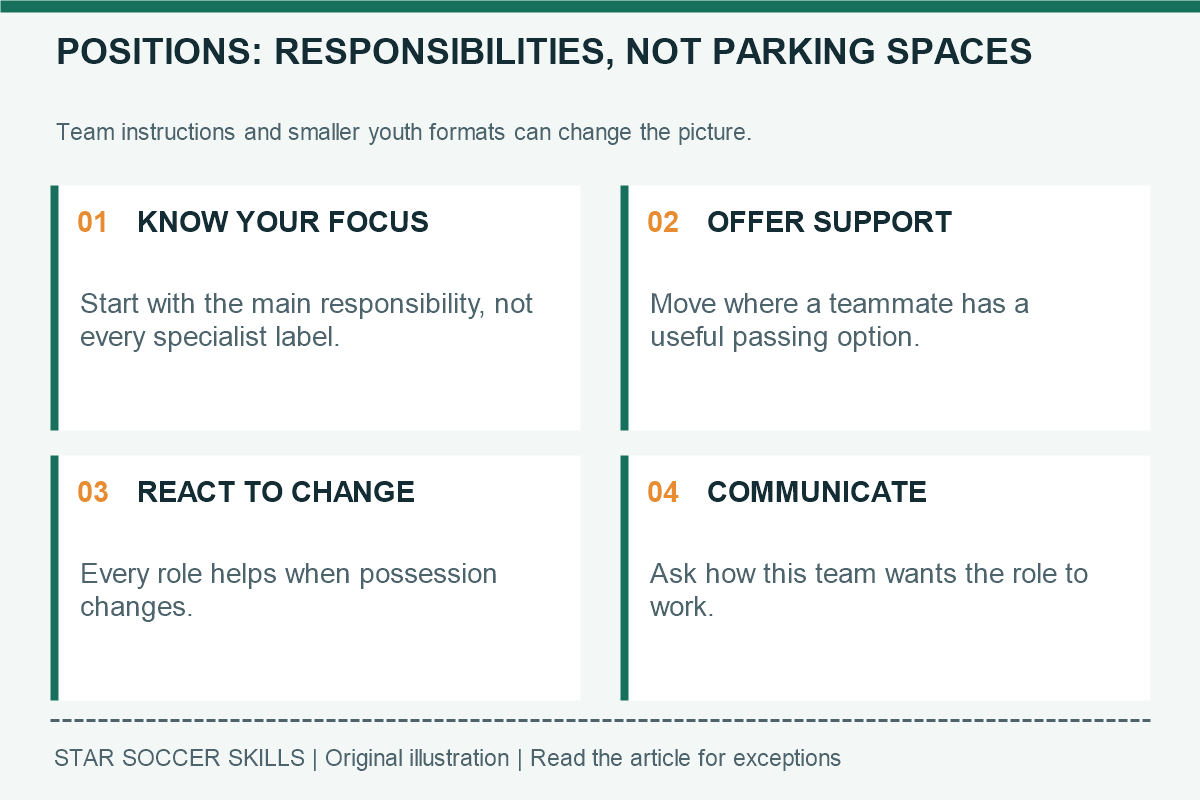
Soccer positions for beginners are easiest to understand as responsibilities rather than places where you must stand. A goalkeeper, defender, midfielder, or forward has a different starting focus, but every player helps the team when possession changes.
This guide explains the main roles in an illustrative eleven-player team and how those ideas become simpler in small-sided soccer. It is about what players do, not memorizing shirt-number conventions. Start with our positioning and tactics lesson to learn width, support, and reacting when the ball changes teams.
The four broad groups
| Group | When the team has the ball | When the opponents have it |
|---|---|---|
| Goalkeeper | Offer a safe option and distribute appropriately | Protect the goal and organize nearby space |
| Defenders | Help begin attacks and support possession | Protect dangerous space and challenge safely |
| Midfielders | Connect teammates and offer passing angles | Recover, screen lanes, and support defending |
| Forwards | Threaten goal, receive, and create space | Help the team regain shape or pressure as instructed |
These are broad descriptions. A coach can ask a fullback to move inside, a forward to drop deeper, or a midfielder to stay behind the ball. The useful question is “What does this team need now?” rather than “Am I allowed to leave my starting spot?”
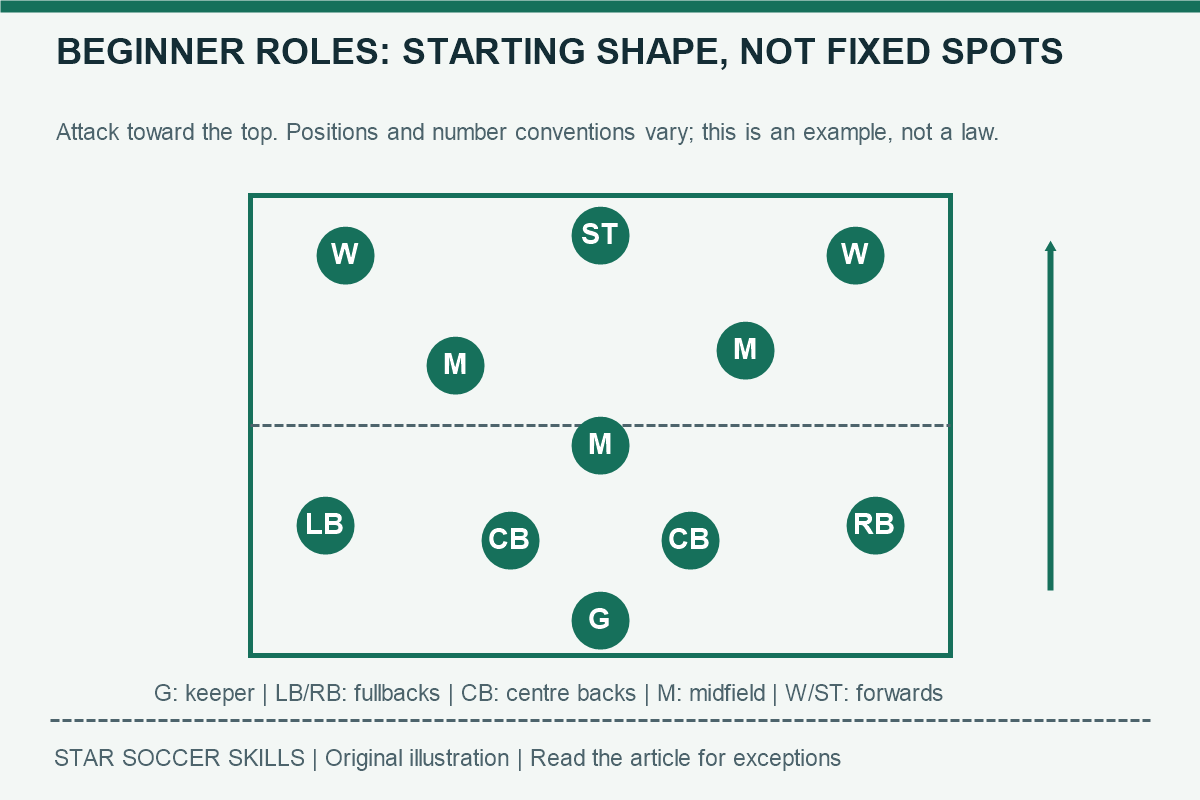
Goalkeeper: more than making saves
The goalkeeper protects the goal but also helps teammates by communicating and offering a passing option. Starting position changes with where the ball is and whether the team can keep possession safely. A keeper does not need to remain on the goal line for the whole match.
Handling privileges apply inside the keeper’s own penalty area and have exceptions. Do not assume the player can pick up every teammate delivery. Learn safe movement first through our goalkeeping lesson, then check the rules used by your competition.
A beginner keeper needs suitable supervision, equipment, and a safe area. Avoid hard shots at an unprepared child or drills that require collisions. Let young players explore the role without making it a permanent assignment based on one session.
Centre backs: protect space and help start play
Centre backs commonly begin in the central defensive area. Without possession, they help protect routes toward goal, stay aware of attackers, and support one another. Good defending is not simply running toward the ball at every opportunity.
With possession, a centre back can offer a safe passing angle, carry into available space when appropriate, or connect with a midfielder. The exact instruction depends on the team’s plan and the pressure. A long clearance is one possible decision, not the definition of the position.
For beginners, use the cue “see the ball and the space you protect.” Our basic defending lesson emphasizes balance, patience, and safe positioning rather than reckless tackles.
Fullbacks and wing-backs: different wide roles
Fullbacks typically start on either side of a back four. They help defend wide areas and can support attacks by offering width or moving into another useful lane. Going forward is not a requirement on every attack; cover and team balance matter.
Wing-backs are often used in a shape with three central defenders and may have broader responsibility along the side. The terms are related but not identical. A diagram alone cannot tell you how high or narrow the coach wants that player to be.
If you are new to a wide role, ask two questions: “Where should I be when our winger has the ball?” and “Who covers if I move forward?” Those answers are more useful than copying a professional’s highlight reel.
Midfield: connect, support, and recover
A holding midfielder often supports in front of the defenders and helps protect central passing routes. A connecting midfielder may move between deeper and more advanced areas. An attacking midfielder may seek space behind the opponents’ midfield to create chances.
The labels describe emphasis, not permission to ignore other tasks. An advanced midfielder still helps when possession is lost; a deeper midfielder can still play a useful forward pass. Look before receiving and move where the passer can see you.
Practice the underlying skills with our passing lesson and first-touch lesson. A comfortable receive-and-pass action matters more to a beginner than learning every specialist role name.
Wingers and strikers: create more than shots
Wingers often start wide, where they can stretch the defense, receive, combine, or move inside. Their useful movement depends on teammates: staying wide can help in one moment, while moving inward can create an opening in another.
A striker commonly provides a central attacking reference. Runs behind, movement toward the ball, and space created for a teammate can all matter. A striker is not failing simply because they do not score in every game.
When the team loses possession, forwards may help pressure the ball or recover into shape, depending on the coach’s instruction. Chasing alone without support is not always effective. Keep communication respectful and focus on the next action.
What changes in 3v3, 5v5, or other youth formats?
Smaller games usually need fewer role labels and more shared responsibility. Players may rotate between protecting the goal, supporting the ball, and attacking space within seconds. A full-size eleven-player formation should not be imposed without regard to the actual format.
Official player numbers, field size, goalkeeper use, and restart rules vary by approved competition. Our small-sided games lesson focuses on learning decisions with fewer players rather than assigning a child a specialist identity too early.
Video: an overview of soccer positions
Every position in soccer explained by Tifo Sports by The Athletic is supplementary viewing. Professional tactical labels can be more detailed than a beginner needs, and teams interpret roles differently. Use it for vocabulary, then ask your coach how the role works in your group.
Frequently asked questions
What is the easiest position for a beginner?
There is no universally easiest role. Every position involves decisions and responsibilities. A suitable coach can simplify the task and let players try different roles.
Should the fastest child always play winger?
No. Speed is only one characteristic, and children develop differently. Use opportunities to learn control, support, defending, and communication across roles.
Can defenders score goals?
Yes. Position labels do not restrict who may score under the Laws. Team instructions and balance determine when joining an attack makes sense.
Further learning
Use our teamwork lesson and complete beginner course. General developmental context: FIFA Training Centre grassroots resources and England Football youth information. Roles here are original simplified explanations, not a universal tactical prescription.
Related guides
Continue with these related topics from our beginner soccer library. New guides in this group will become available as they are published.
Leave a Reply