Soccer Goalkeeper Rules: Handling and Restarts Explained
Soccer goalie rules give the goalkeeper a limited handling privilege, not a separate set of rules everywhere on the field. Inside their own penalty area, keepers can usually use their hands, but teammate deliveries, rehandling, holding time, and restarts create important exceptions.
Rules check: this guide was checked against IFAB’s 2026/27 Laws on October 29, 2026. It includes the eight-second holding rule and the separate five-second referee countdown for an unfairly delayed goal kick. Confirm the law edition and approved modifications used by your competition. Our goalkeeping lesson covers beginner movement and handling technique.
Where can a goalkeeper handle the ball?
The handling privilege applies inside the goalkeeper’s own penalty area, not only the smaller goal area. Outside that penalty area, a keeper is subject to the normal handball rules. Being a goalkeeper does not allow catching in the opponents’ penalty area either.
The position of the ball matters, not simply where the goalkeeper’s feet are. A keeper standing outside their area may reach toward a ball inside it, while standing inside does not authorize handling a ball that is outside. Boundary lines belong to the areas they enclose, so the penalty-area line is part of the area.
Do not confuse the penalty arc with an extension of the area. The arc marks distance for a penalty kick; it does not create extra space in which the goalkeeper can catch the ball.

Which teammate deliveries restrict handling?
A keeper normally cannot touch the ball with a hand or arm after a teammate deliberately kicks it to them, or when receiving it directly from a teammate’s throw-in. The keeper may ordinarily play those deliveries with the feet. A genuine header in ordinary play is different from a deliberate trick designed to evade the rule.
There is a specific exception when the keeper has clearly kicked or tried to kick the restricted delivery to release it into play. A genuine mishit clearance may therefore allow recovery with the hands inside the penalty area. Simply taking a settling foot touch is not a universal workaround.
The deliberate foot pass does not have to travel backward. For close examples and the circumvention rule, read the dedicated back-pass article linked in the related guides below. For safe distribution technique, use our passing lesson.
The eight-second hand-control rule
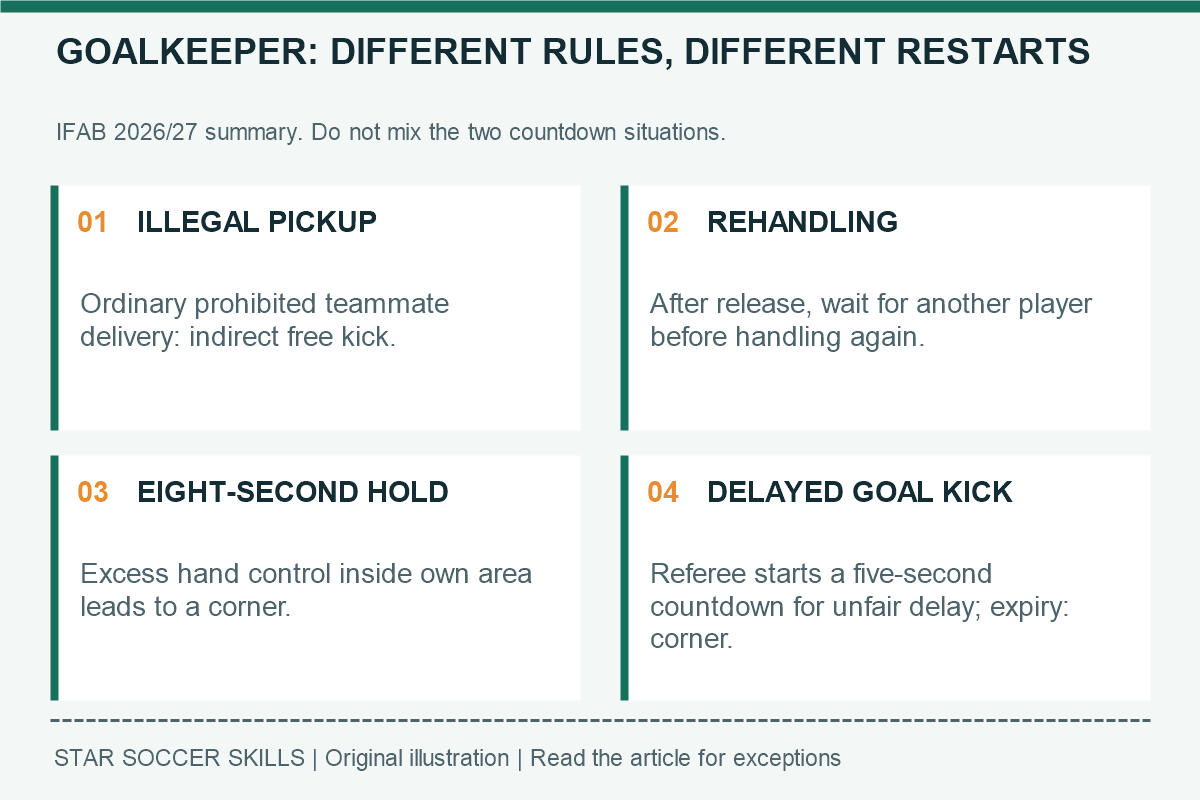
A goalkeeper who controls the ball with the hands or arms inside the penalty area for more than eight seconds before releasing it is penalized with a corner kick to the opponents. This is not the old six-second indirect-free-kick description still repeated in some older guides.
The referee decides when control begins and shows a raised-hand visual countdown for the final five seconds. Hand control includes holding the ball between hands or arms and another surface, holding it on an outstretched open hand, and bouncing it or tossing it in the air.
Bouncing the ball does not reset the clock. Nor does switching it from one hand to the other. The corner is taken from the side nearest the keeper’s position when penalized, according to the corner-kick procedure.
The eight-second limit is not an automatic clock for dribbling with the feet. That does not permit other forms of delaying a restart or misconduct, but it is important to identify the actual rule rather than assume every goalkeeper possession has the same time limit.
Can an opponent challenge a keeper holding the ball?
An opponent cannot challenge the keeper while the ball is under hand or arm control. Players also cannot prevent release or kick, or try to kick, the ball while the goalkeeper is in the process of releasing it. Waiting nearby does not authorize a dangerous attempt to take it from the keeper’s hands.
Goalkeepers are not immune from every lawful challenge simply because they are in the penalty area. The referee considers whether the keeper has control and whether an action is careless, reckless, dangerous, or uses excessive force. Do not turn a rules discussion into a drill where children collide or kick at a held ball.
Can a keeper put the ball down and pick it up again?
After releasing controlled possession, the keeper cannot touch the ball with a hand or arm again before another player touches it. Rolling it out, dribbling a few steps, and then picking it up is not automatically allowed.
A rebound while making an initial save is not necessarily the same as releasing established hand control. The referee assesses what happened. Avoid the oversimplified claim that any ball touching the keeper’s hands once makes a later recovery illegal.
| Situation | Usual outcome |
|---|---|
| Keeper catches an opponent’s shot inside their own penalty area | Normally permitted |
| Keeper makes an ordinary prohibited pickup of a deliberate teammate foot pass | Indirect free kick, not an automatic penalty |
| Keeper rehandles after releasing control, before another player touches it | Indirect free kick |
| Keeper exceeds eight seconds of hand or arm control | Corner kick for the opponents |
| Keeper commits a handball offence outside their own penalty area | Direct free kick; any disciplinary sanction depends on the circumstances |
| Team fails the referee’s delayed goal-kick countdown | Corner kick for the opponents |
Goal kicks are a separate restart
A goal kick is taken from anywhere within the goal area by a defending player; it does not have to be the goalkeeper. The stationary ball is in play when kicked and clearly moving. It no longer has to leave the penalty area before a teammate can receive it.
Opponents must normally be outside the penalty area until the ball is in play. Law 16 has specific provisions for opponents who did not have time to leave, so avoid treating every quick restart with an attacker still nearby as an automatic foul.
The kicker cannot play the ball a second time until another player touches it. A goalkeeper who double-touches a goal kick to stop a promising attack or deny a goal-scoring opportunity can face discipline; that differs from an ordinary prohibited pickup during open play.
The five-second delayed goal-kick countdown
Under the 2026/27 rule, when a player unfairly delays a goal kick, the referee whistles and signals a visual five-second countdown. If the kick has not been taken by its end, the opponents receive a corner.
This is not a universal requirement to take every goal kick within five seconds of the ball crossing the goal line. It begins with the referee’s response to unfair delay. It is also not the same as the final-five-second signal within the goalkeeper’s eight seconds of live hand control.
Video: the eight-second change
8 Second GK New Law Changes 2025 by Colorado Soccer Association is supplementary viewing about the holding-rule change. Its title refers to the earlier introduction of that rule; do not expect it to cover the separate 2026/27 goal-kick countdown. Check the current IFAB sources for the complete requirements.
Frequently asked questions
Can the goalkeeper score?
Yes, subject to the scoring and restart rules. A ball thrown directly from the keeper’s hand into the opponents’ goal does not count; the restart is a goal kick. A legal kick can produce a goal in circumstances where the relevant law permits it.
Is every keeper handball a red card?
No. Ordinary prohibited handling inside the keeper’s own penalty area is normally an indirect free kick without an automatic card. Outside-area handball, restart double touches, and other misconduct require their own disciplinary analysis.
Can a teammate take over as goalkeeper?
A player already on the field can exchange duties with the keeper during a stoppage if the referee is informed. A bench replacement must follow the applicable substitution procedure.
Official sources
Primary sources: IFAB Law 12, Law 16, Law 17, Law 3, and Law 10. These original explanations do not replace the official Laws or competition regulations.
Related guides
Continue with these related topics from our beginner soccer library. New guides in this group will become available as they are published.
- Soccer Back-Pass Rule: When Can the Goalkeeper Use Their Hands?
- Soccer Substitution Rules: Youth Leagues vs. Professional Matches
- Soccer Throw-In Rules Explained with Common Mistakes
[…] especially in youth or small-sided play. Start with our soccer basics lesson if the field markings and restarts are new to […]
[…] Soccer Goalkeeper Rules: Handling and Restarts Explained […]
[…] Soccer Goalkeeper Rules: Handling and Restarts Explained […]