Soccer Back-Pass Rule: When Can the Goalkeeper Use Their Hands?
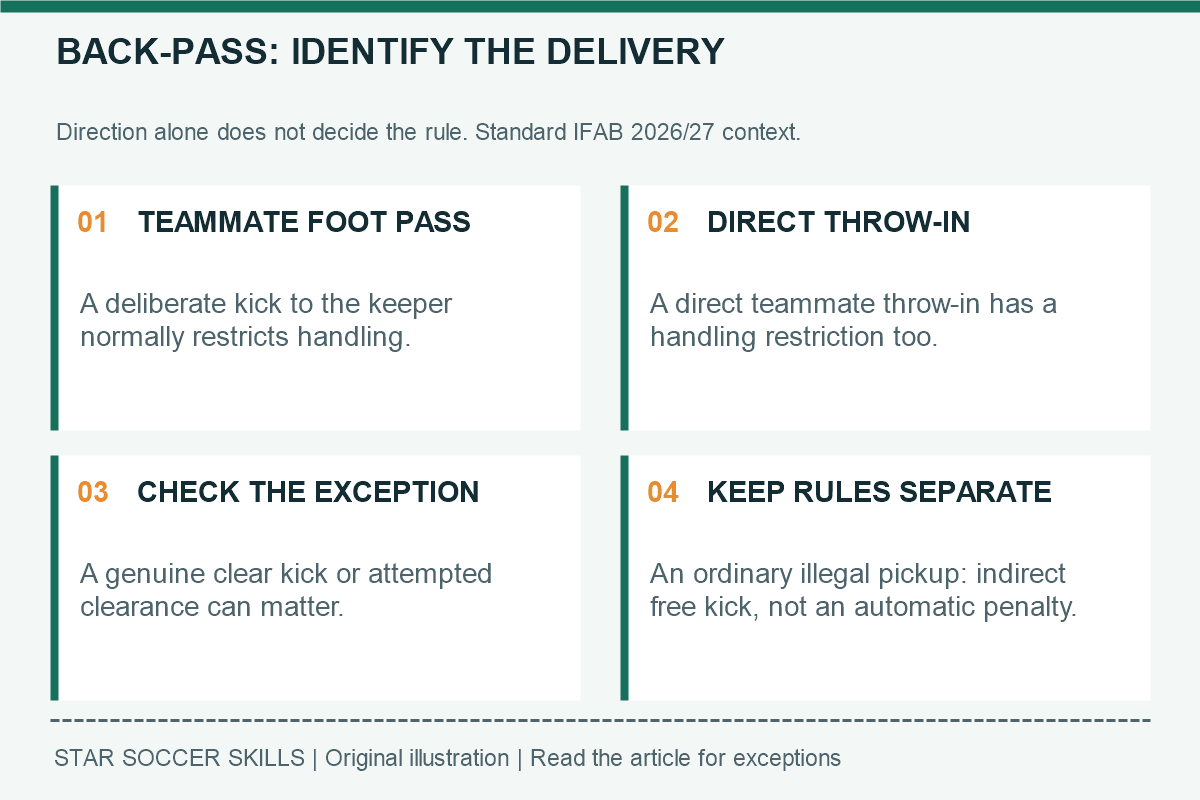
The soccer back pass rule does not prohibit passing to your goalkeeper. It restricts when the goalkeeper can use the hands or arms after certain teammate deliveries. A teammate can pass backward, sideways, or even forward to the keeper; direction alone does not decide whether handling is legal.
Rules check: this guide uses the IFAB 2026/27 Laws, checked on October 29, 2026. It covers standard association football rather than futsal or an individual youth league’s modified rules. Our goalkeeping lesson introduces basic positioning and control; this article focuses on the handling restriction.
The rule in plain English
Inside the goalkeeper’s own penalty area, the keeper normally cannot touch the ball with the hand or arm after a teammate has deliberately kicked it to them. The same restriction applies when the keeper receives the ball directly from a teammate’s throw-in. A genuine clear kick or attempted kick to release the ball into play provides a specific exception discussed below.
If the keeper simply receives such a pass and plays it with the feet, there is no back-pass handling offence. A team can build play through its goalkeeper. Pressure from an opponent does not itself grant permission to pick the ball up.
The nickname “back-pass” can be misleading. A defender passing sideways across the penalty area to the keeper can trigger the restriction; a ball traveling backward after an opponent’s shot does not become an illegal teammate pass merely because of its direction.
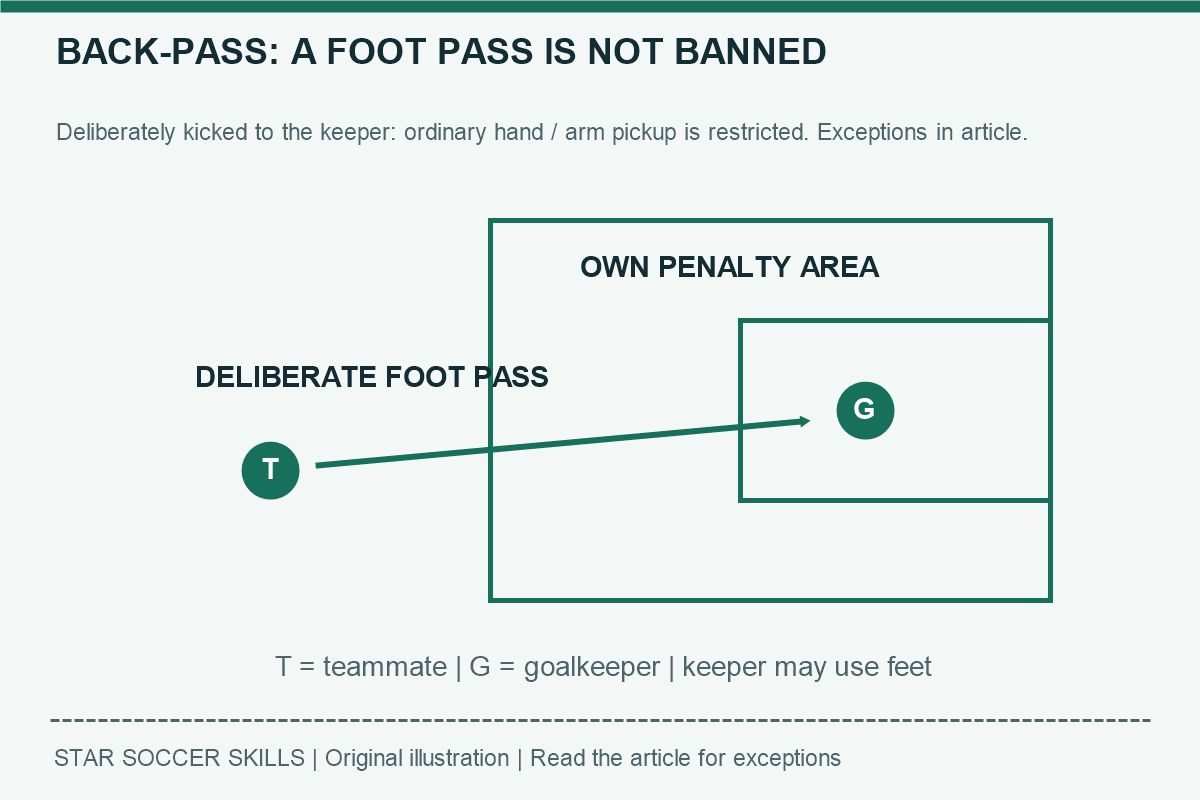
What does deliberately kicked to the keeper mean?
The referee considers the player’s action and intended delivery, not whether the team benefited. A clear intentional foot pass to the goalkeeper is the straightforward case. A ricochet off a teammate is not automatically the same as a deliberate kick to the keeper.
A miskick or deflection needs context. It is not safe to say every ball that touches a teammate’s boot is prohibited, or that every awkward clearance is exempt. The question is whether the ball was deliberately kicked to the goalkeeper. Players should avoid trying to referee a borderline action while an opponent is approaching.
If the teammate uses a genuine header, chest contact, or knee contact in ordinary play, the foot-pass restriction does not automatically apply. However, a manufactured trick designed to get around the rule is a separate offence.
Common scenarios and decisions
| Scenario | Handling inside the keeper’s penalty area |
|---|---|
| Defender deliberately passes with the foot to the keeper | Not normally allowed; keeper can play with the feet |
| Teammate throws the ball directly to the keeper from a throw-in | Not normally allowed |
| Teammate makes a genuine header during ordinary play | Generally allowed, unless it is a deliberate circumvention trick |
| Opponent shoots and the keeper makes a save | Normally allowed inside the keeper’s own penalty area |
| Ball merely ricochets off a teammate | Not automatically a deliberate kick to the keeper; referee assesses the action |
| Keeper genuinely attempts a clearance, miskicks, then catches | The specific clear-kick or attempted-kick exception may apply |
| Keeper drops a controlled ball, then picks it up before anyone else touches it | Normally prohibited by the separate release-and-rehandle rule |
The genuine attempted-clearance exception
Law 12 allows handling after the restricted teammate delivery if the goalkeeper has clearly kicked or attempted to kick the ball to release it into play. This covers a genuine clearance attempt that goes wrong, rather than treating every miskick as a reason the keeper must allow an avoidable collision.
For example, a keeper receives a deliberate teammate pass, clearly attempts to clear it, and mishits it so it remains nearby. The exception can permit the keeper to recover it with the hands inside the penalty area.
Do not turn this into “touch it once with your foot and then pick it up.” A settling touch or an ordinary dribble is not automatically a clear attempt to release the ball into play. It also does not cancel the separate restriction on picking up a ball the keeper previously released from hand control.
Headers and the deliberate-trick rule
A player cannot manufacture a workaround by flicking the ball up with the foot and then using the head, chest, or knee to send it to the keeper to evade the law. This can be penalized even when the goalkeeper never actually touches the ball with the hands.
The player responsible for initiating the deliberate trick is penalized with an indirect free kick and a caution. If the goalkeeper initiates the trick, the keeper can be the player penalized. The rule also applies to an attempted workaround from a free kick or goal kick.
Contrast that with a defender heading a genuine high cross back during ordinary play. The body part alone is not the whole decision; whether the action was a deliberate attempt to circumvent the restriction matters.
What is the punishment for illegal handling?
For an ordinary prohibited pickup inside the goalkeeper’s own penalty area, the restart is an indirect free kick, not an automatic penalty kick. It is usually taken where the handling occurred. If the offence is inside the goal area, the attacking indirect free kick moves to the nearest point on the goal-area line parallel to the goal line.
There is no automatic card for that ordinary handling breach. Do not confuse it with the deliberate-trick offence, or with a goalkeeper’s second-touch offence after a restart that can stop a promising attack or deny a goal-scoring opportunity. Those have different disciplinary considerations.
Outside the goalkeeper’s own penalty area, normal handball restrictions apply. The keeper does not gain a special right to handle by standing in the penalty area while reaching for a ball outside it. The ball’s position matters.
Video: a back-pass explainer
What You Didn’t Know About The Back-Pass Rule by Paul Spacey is an external explainer. Use it as supplementary viewing, not as the authority for every exception or current sanction. The written guide and linked IFAB Laws identify the current rule edition.
A useful habit for players
Before receiving, the goalkeeper can look for a safe next pass and communicate with the defender. The defender can choose a manageable pass rather than sending the ball into unnecessary pressure. Build these skills with our passing lesson and first-touch lesson.
Practice slowly in a suitable supervised setting. Do not rehearse collisions or use the handling exception as a tactic to invite a challenge. The objective is a comfortable decision with the feet, not discovering how close to an offence a player can get.
Frequently asked questions
Does the pass have to travel backward?
No. A deliberate foot pass to the keeper can trigger the handling restriction regardless of its direction.
Can the keeper catch a direct teammate throw-in?
Normally no. That restriction is specifically included alongside deliberate teammate kicks, with the genuine clear-kick or attempted-kick exception.
Can a goalkeeper keep dribbling after a teammate pass?
Normally yes, while complying with the other laws. The eight-second rule is about hand or arm control inside the penalty area, not an automatic limit on playing with the feet.
Official sources
Primary sources: IFAB Law 12 for handling, deliberate tricks, and discipline; Law 13 for indirect-free-kick placement; and Law 15 for throw-ins. This article is an original explanation; the official Laws and competition regulations govern the match.
Related guides
Continue with these related topics from our beginner soccer library. New guides in this group will become available as they are published.
Leave a Reply