Soccer Throw-In Rules Explained with Common Mistakes
Soccer throw in rules cover more than keeping both feet down. A legal throw-in has a required location and throwing action, opponents must give space, and the thrower cannot immediately play the ball a second time. Under the 2026/27 Laws, deliberately delaying the restart can also trigger a referee’s five-second visual countdown.
Rules check: this guide was checked against the IFAB 2026/27 Laws of the Game on October 29, 2026. It explains standard association football, not futsal. Confirm which law edition and approved modifications your competition uses, especially in youth or small-sided play. Start with our soccer basics lesson if the field markings and restarts are new to you.
When is a throw-in awarded?
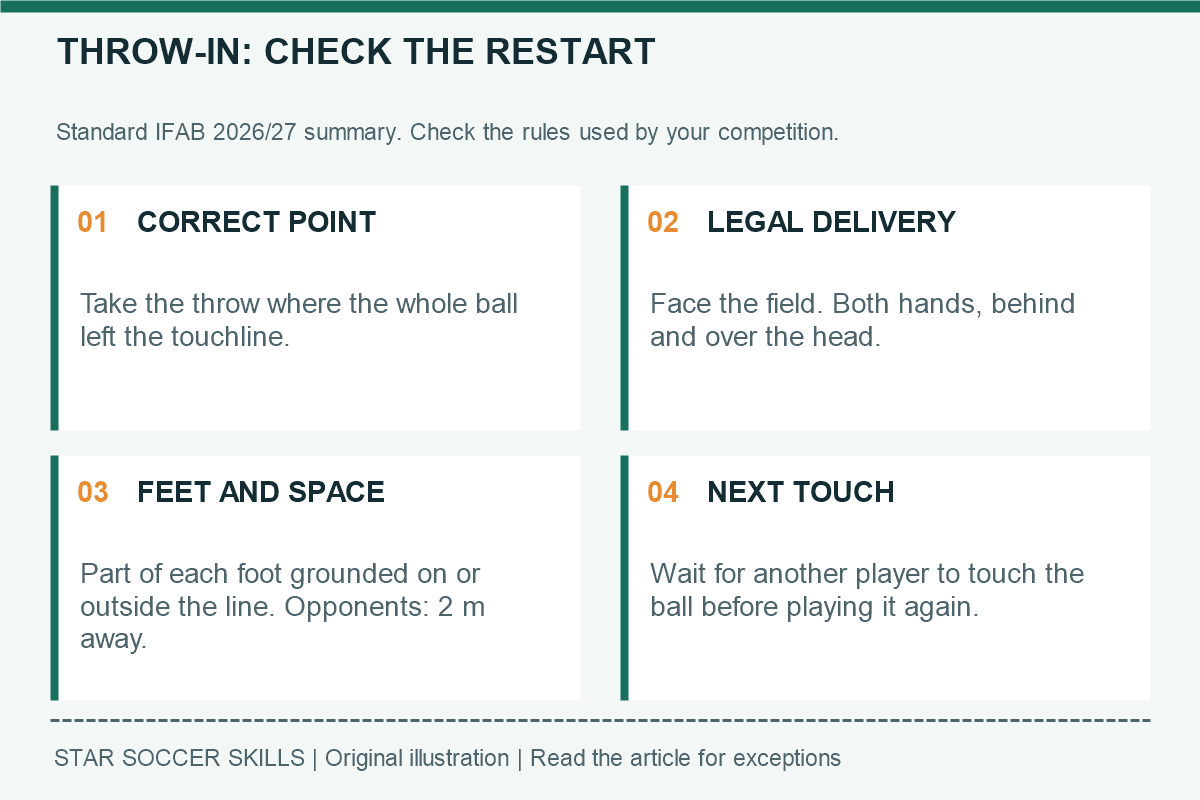
A normal throw-in follows the whole ball crossing the touchline, either along the ground or in the air. It belongs to the opponents of the player who touched the ball last. A ball partly over the line is not yet out, and a player being outside the field does not itself make the ball out.
The restart is taken at the point where the ball left the field, not wherever a player happens to collect it. The current law also allows possession to change through the delayed-throw-in countdown procedure described below. A goal-line exit normally involves a different restart, not a throw-in.
The legal throwing action
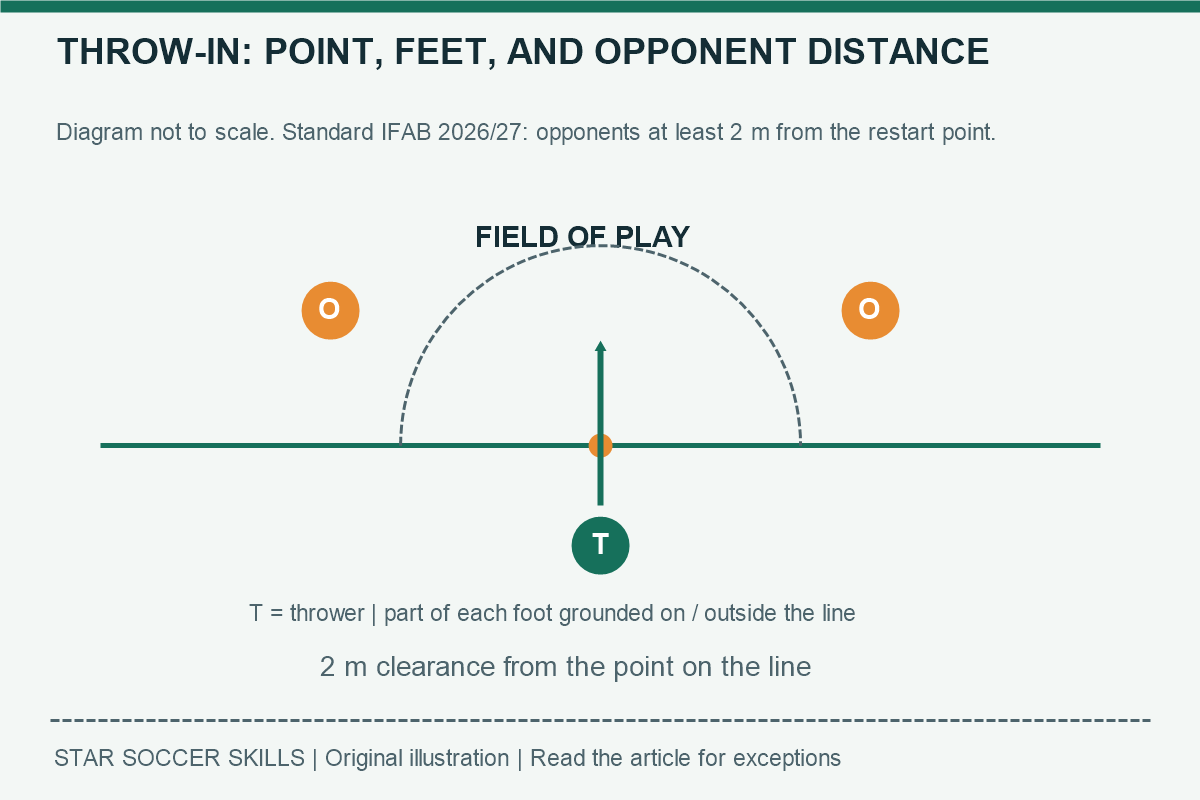
At the moment the ball is delivered, the thrower faces the playing field, uses both hands, and brings the ball from behind and over the head. Part of each foot must be on the touchline or on the ground outside it. Both feet do not have to be entirely behind the line.
A run-up is not automatically illegal, but the delivery must still satisfy those conditions. Lifting a foot completely off the ground during release, throwing with one hand, or delivering from the wrong location can make the throw incorrect. A powerful or unusual-looking action is not the test by itself.
Keep coaching simple: face the field, set your feet, bring the ball behind and over your head, then release with both hands. Do not copy a demanding acrobatic technique as a beginner. Practice only in a clear area, with an appropriate ball and suitable supervision for children.
How far away must opponents stand?
Opponents must stay at least 2 metres from the point on the touchline where the throw-in will be taken. That is a distance from the restart point, not permission to move close because the thrower stands farther back.
An opponent who unfairly distracts or impedes the thrower can be cautioned for unsporting behaviour. If the throw-in has already been taken, the law provides an indirect free kick for that interference. A teammate receiving the throw has no equivalent universal two-metre restriction under this rule.
When the ball becomes live
The ball enters play when it enters the field. If it hits the ground before entering, the same team retakes from the same location. That situation is different from an incorrectly performed throw, which ordinarily gives the throw-in to the opponents.
Once the ball is in play, the thrower must wait until another player touches it before playing it again. A throw that comes back off the referee or an object is not automatically a touch by another player. The usual second-touch restart is an indirect free kick; a handball offence has its own direct-free-kick or penalty provisions.
The 2026/27 five-second countdown
Do not describe the current rule as “every throw-in must happen within five seconds of the ball going out.” The referee first identifies unfair delay, whistles and signals, then starts a visible five-second countdown with a raised hand. If the throw-in is still not taken when that countdown ends, the opponents receive it.
The player is not automatically shown a yellow card simply because the countdown expires. Under this procedure, a caution applies if the player then excessively delays the restart after it has been awarded to the other team. Other misconduct can still have separate consequences.
This makes two habits useful: return to the correct location promptly and have a simple receiving option ready. The countdown is the referee’s responsibility, not a reason for spectators to demand a turnover whenever they count five seconds themselves.
| Situation | What normally happens |
|---|---|
| Part of each foot is on the touchline at release | That foot position is allowed if the other requirements are met |
| One foot is completely off the ground at release | Incorrect throw; opponents take the throw-in |
| Ball hits the ground before entering the field | Same team retakes from the same place |
| Thrower plays the ball again before another player touches it | Normally an indirect free kick; handball requires separate consideration |
| Referee’s unfair-delay countdown expires | Throw-in is awarded to the opponents |
| Ball goes straight into the opponents’ goal | No goal; goal kick |
| Ball goes straight into the thrower’s own goal | No own goal; corner kick |
Can you be offside from a throw-in?
A player cannot commit an offside offence simply by receiving the ball directly from a throw-in. The word directly matters: once a teammate subsequently plays or touches it, the usual offside assessment may become relevant.
This does not give a receiving player permission to foul, hold, or interfere unlawfully with an opponent. Read our offside explainer for the distinction between offside position and an actual offence.
Can the goalkeeper catch a teammate’s throw-in?
Not when receiving it directly from that teammate. Inside the goalkeeper’s own penalty area, touching that direct throw with the hand or arm is an indirect-free-kick offence, subject to the law’s genuine attempted-clearance exception. The goalkeeper can normally play it with the feet instead. This restriction is separate from the rule against handling a deliberately kicked teammate pass.
Video: a throw-in technique reference
Learn the Rules of a Soccer Throw In by SIKANA English is an external visual reference. Older demonstrations may not include the 2026/27 delay-countdown change. Use the current IFAB sources below for decisions and sanctions; the video is not a substitute for the applicable law edition.
Frequently asked questions
Can you score directly from a throw-in?
No. Without another player’s touch, a throw into the opponents’ goal produces a goal kick; a throw into your own goal produces a corner. A goal may result after a legitimate intervening touch, subject to the other laws.
Is a foot touching the line a foul throw?
No. Part of each foot may be on the touchline. The issue is the foot position and contact with the ground at delivery, together with the other throwing requirements.
Do young children always use these exact restarts?
No. A youth competition may use approved age-specific formats, and a coach may simplify a training game. Check local regulations rather than assuming a kick-in or retake allowance is a universal match law.
Official sources
Checked against IFAB Law 15: The Throw-in, Law 11: Offside, Law 12: Fouls and Misconduct, and the 2026/27 changes summary. Explanations and illustrations are original paraphrases, not a replacement for the official Laws.
Related guides
Continue with these related topics from our beginner soccer library. New guides in this group will become available as they are published.
Leave a Reply