What is offside in soccer, and how does it work?
Can a player stand in an offside position and still be legal? Yes, and that surprises many new fans. An attacking player who stands behind the last defender and receives a pass from a teammate is the classic offside situation.
The offside rule is one of the first soccer rule basics every fan should learn. It stops an attacking player from waiting near the goal for a pass sent behind the defending team. The second-last opponent is the defender second closest to the attacking team’s goal line. This is usually the last outfield defender, because the goalkeeper is normally the last opponent.

Only the moment the ball is played matters, not the moment the attacker receives it. Standing in an offside position alone is not an offense. A flag or video review can follow a teammate’s pass before the referee decision is made.
Key Takeaways
- Offside is judged at the moment the ball is played.
- Standing in an offside position is not an offense by itself.
- An attacker is penalized only when involved in active play.
- Only the head, body and feet count, never the hands or arms.
- The second-last opponent is usually the final outfield defender.
- A flag or video review can follow a teammate’s pass.
Explaining Offside to a Child or New Fan
Imagine the ball is kicked and an attacker is closer to the goal than the last defender at that exact moment. That is the core of offside, and it is the easiest way to explain offside to a child. The child only needs to remember one question: was the player too far forward?
Offside is about position at the moment of the pass, not about what happens later. Offside soccer is easiest to learn with one simple picture. The offside rule works the same way in every match, so the picture helps from the first game.
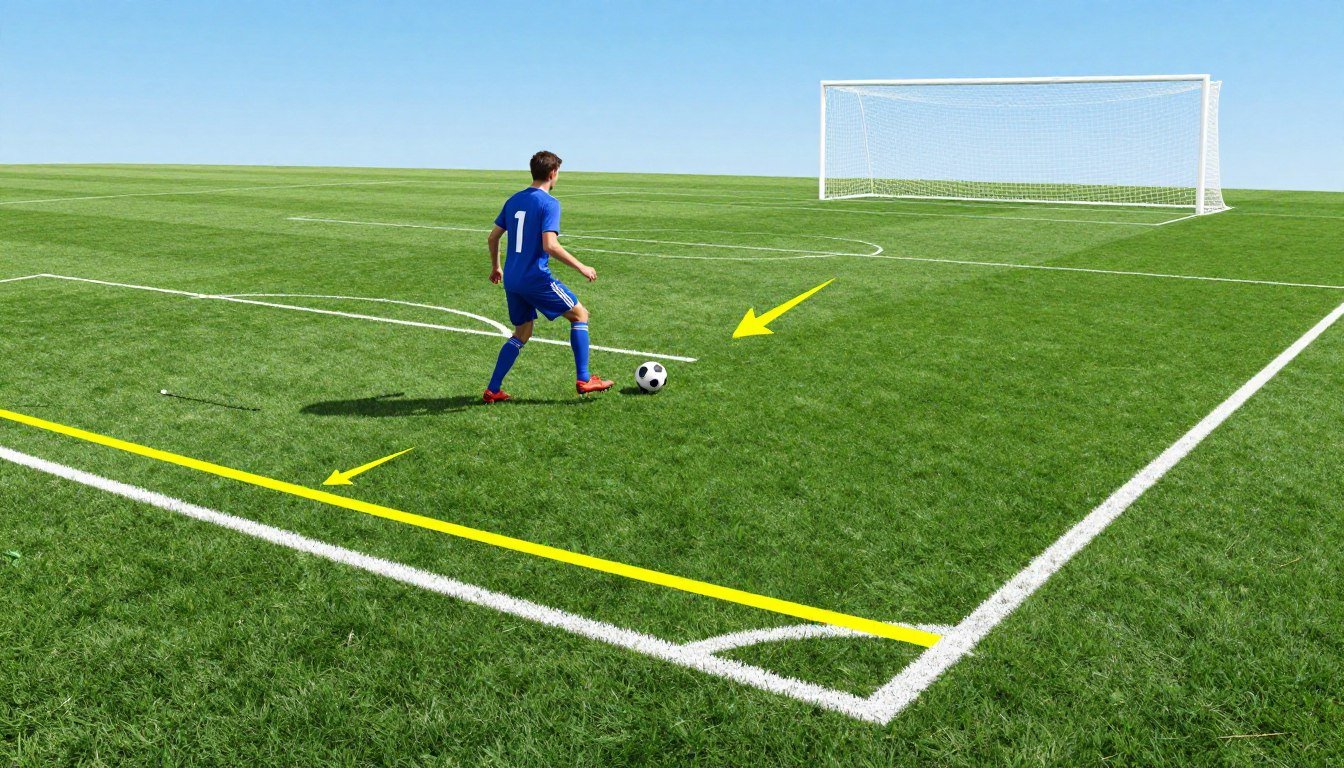
Too far forward when the pass is kicked means offside.
The Simple Version for Kids
A parent can explain offside in soccer to a child with one short rule. The goalkeeper is the last opponent, and the defender standing just in front of that player is the second-last opponent. An attacker ahead of that defender when the ball is kicked may be called offside.
Using a Picture or Diagram
Draw a long line across a sheet of paper to show the goal line. Then draw a second line through the second-last defender, parallel to the first. Any attacker between that second line and the goal, at the moment of the pass, is in an offside position.
Checking Your Understanding in a Game
Ask three quick questions during play. Is the attacker in the opponents’ half? Is the attacker closer to the goal than the second-last defender? Is the pass being played right now? Attacker timing matters most, because the call depends on the moment of the kick.
Watching the defender’s feet at the moment of the pass shows whether the attacker was too far forward.
Why the Offside Rule Exists
Without the rule, an attacker could stand beside the goalkeeper and wait for every long pass. The offside rule purpose is simple: attacking players must join the play, not wait for it. The rule keeps the match from turning into a contest of who can kick the ball farthest.
The rule keeps defenders from being beaten by one long ball after another. Without it, many matches would become a string of long balls over the top. Defenders would have no reason to hold a line, and the game would lose its shape.

The rule also makes a team earn a chance near goal. Teams must move the ball through the middle, dribble past players and use short passes to reach the danger zone. That makes the game more about skill and teamwork than about one kick.
Coaches often teach strikers to time a run, so they arrive level with the defense instead of in front of it. A striker who moves early can drag defenders out of position, while a striker who waits near goal gains nothing. The rule pushes players to think about movement, not just position.
The rule rewards timed runs, so attackers who move before the pass are not penalized.
Where the Offside Position Applies
A player is offside only when a part of the body is closer to the goal line than both the ball and the second-last opponent. The check happens at the moment the pass is played, not earlier in the move. The body part must also sit in the opponents’ half to count.
A player in the opponents’ half is in an offside position only if a body part is nearer the goal line than both the ball and the second-last opponent. The halfway line itself does not count, so a player standing on it is never in the zone. Players in their own half cannot be in an offside position.
- head body feet: these body parts count toward offside.
- Hands and arms: ignored for all players, goalkeepers included.
- Level with the second-last opponent: onside, not offside.
- Halfway line: excluded from the opponents’ half.
- Goalkeeper: counts as an opponent when finding the last two players.
- Moment of the pass: the only time the position is judged.
Most fans check the whole player first, and that is the mistake. Start with the body parts that count. Look at where the ball is, then find the second-last opponent. Only then decide whether the attacker is too far forward.
Check the attacker’s feet or torso first, since a raised hand or arm never makes the attacker offside.
When Being in an Offside Position Becomes an Offence
A player standing in an offside position who never touches the ball commits no offense. Can a player be offside without touching the ball? Yes, the player can be in the zone and still stay legal. The offense starts only when the attacker becomes involved in play after the pass.
An attacker in an offside position is penalized only when involved in active play. Active play means taking part in the play, such as receiving the pass or stopping the ball. A player who waits in the zone without getting involved is safe.
| Situation | Offside offense | Reason |
|---|---|---|
| Receives the pass | Yes | Playing the ball is active play |
| Obstructs a goalkeeper’s view | Yes | Clearly blocks the line of vision |
| Rebound off the crossbar | Yes, if it gives an advantage | The attacker gains an advantage from the ball |
Interfering with Play and Opponents
Interfering with an opponent includes clearly obstructing the goalkeeper’s line of vision. It also covers challenging for the ball or taking an obvious action that changes what the opponent can do. A quick step into the keeper’s sightline can be enough for a call.
Gaining an Advantage from a Rebound or Save
A save by the goalkeeper that bounces to an attacker who was in an offside position counts as active play. The attacker must gain an advantage from the ball to be penalized. A rebound that lands with no benefit to the attacker does not create an offense.
When the Offence Does Not Occur
A late run that stays out of the line of vision does not count. Players who drift forward without touching the ball or blocking anyone are not penalized. Staying out of the goalkeeper’s line of vision keeps a late run from becoming an offense.
Restarts and Deliberate Play
A pass from a defender who clearly means to play the ball cancels most of the offside concern. An attacker who receives a deliberate pass from an opponent is not penalized for gaining an advantage. This holds even when the defender uses a deliberate handball to play the ball.
A deliberate play is one where the player controls the ball with a chance to pass, gain possession or clear it. Referees look at four things when judging whether a play was deliberate.
- Distance: the defender has a clear view of the ball.
- Pace: the ball is slow enough to control.
- Direction: the ball goes where the defender expects.
- Time: the defender has time to coordinate the body.
An offense that still stands gets a restart. The defending team’s restart is an indirect free kick, taken from the spot where the offense occurred. That spot can be in the attacking player’s own half if the offense happened there.
An inaccurate pass by the defender still counts as deliberate, so the attacker is not helped by that error.
Checking Offside Calls with Officials and Video
The assistant referee on the sideline usually makes the first offside call. They keep in line with the second-last opponent and signal with a flag. The referee can overrule an assistant referee’s flag when the main official sees the play differently.
- Flag raised and held: a possible offside the referee may review.
- Flag raised, then lowered at once: an obvious offside.
- Flag kept down: no offside signal.
The Assistant Referee’s Role
The assistant referee watches the attacker and the second-last opponent at the moment the ball is played. The flag tells the referee and the players what the official saw. Fans can see the flag, but the final word belongs to the referee.
How VAR and Semi-Automated Technology Help
Video Assistant Referee technology was first used in 2018. In matches using VAR, assistant referees hold the flag until play reaches a natural stop, unless the offside is obvious. Semi-automated offside technology adds sensors to the ball and cameras that track points on the players’ bodies.
Why Close Calls Stay Controversial
A camera from the side can make a player look level when one player is actually closer to the camera. Human judgment on the timing of a pass also stays open to debate. Watch for the flag held up during play, since it means a video check may follow.
Why Offside Calls Are So Close
Players moving toward each other can separate by two meters in less than a second. That speed leaves little time to judge where each player stood when the ball was played. Many offside decisions look disputed for that reason alone.
Most offside controversy comes from split-second timing and camera angles, not from a lack of rules. The table shows three common reasons these calls get argued.
| Cause | Effect | Example |
|---|---|---|
| Interference judgment | The referee must judge intent and impact | A defender’s arm blocks a view |
| Timing of the pass | A small gap changes the call | Ball played a split second before the run |
| Camera angle | Players look level when they are not | Side-on view of a striker and defender |
Human judgment depends on one look at fast play. Semi-automated technology measures positions with sensors, so it gives a more exact line than the eye can. Even so, the call still depends on the point the ball leaves the passer’s foot.
A close call usually turns on the exact moment the ball was played, so that moment is worth watching.
How the Offside Law Changed Over Time
The offside law of 1863 was much stricter than the rule used today. In 1863 a player in front of the ball was offside, with a goal kick as the only exception. Almost any attacker near the ball could be called offside.
The 1863 law treated almost every forward player as offside, so the rule was far harsher than it is now. In 1866 at least three opponents had to be between the player and goal. That number was later reduced to two.
The 1990 wording change replaced “interfering with play or with an opponent” with “seeking to interfere with play or with an opponent.” It took effect for the 1990/91 season. The change made the rule about intent, not only about where a player stood.
In May 2005, FIFA put the body part test into the law text. Any part of the head, body or feet nearer the goal line than the ball and second-last defender counts, while arms are excluded. The 2017 wording also excluded hands and arms in clear terms.
The current wording asks whether the attacker is seeking to interfere, not whether they simply stand in the zone.
Upcoming FIFA Offside Proposal and the 2026 World Cup
Every World Cup offside decision uses the current law today, and that law counts any part of the body except the arms. A new offside rule at the World Cup is not in force, so the current law still applies. Fans should expect the same wording in any match they watch.
The current rule still applies at the World Cup. FIFA is studying a proposal that would change the margin from any body part to something stricter. Under that idea, an attacker is offside only if entirely ahead of the penultimate defender.
The penultimate defender is another name for the second-last opponent. The idea comes from Arsène Wenger, a former Arsenal manager. Under the idea, a player with any body part level with the penultimate defender would stay onside.
The FIFA offside proposal for 2026 is still under study, and no start date has been set for it. The proposal has not been adopted, so the current wording still governs every decision. Fans who watch closely will see the same checks on the body parts and the second-last opponent.
Until a change is announced, the current law is the one that applies in each match.
Common Offside Mistakes Fans Make
Most wrong offside calls come from a fan counting the wrong body part. A fan who sees a raised arm and calls offside has made a clear mistake. A player in their own half is never offside, even if that player is ahead of everyone else on the field.
Where a player started the run does not decide offside. Where the ball was played does.
Many fans also judge a run by how far the player moved, not by where the player stood at the moment of the pass. That shift in focus causes most of the arguments after a match. Freeze the moment the ball leaves the passer’s foot in your mind before you judge.
- Counting an arm or hand as the offside body part.
- Treating a player level with the defender as offside.
- Forgetting the goalkeeper counts as an opponent.
- Calling offside on a throw-in, which never creates an offside offense.
Check the moment of the pass before deciding.
Conclusion
Offside comes down to timing and position at one instant. The offside position is judged at the moment of the pass. An attacker in that position is penalized only when they become involved in active play.
Keep those two checks in mind as you watch. Position is the first question, and involvement is the second. Together they explain most calls you will see on the field.
Watch the next match and freeze the moment the ball is played to check the attacker’s position.