Soccer Kickoff Rules: Positioning and Common Questions
Soccer kickoff rules are straightforward once you separate the setup from the moment the ball becomes live. The ball is stationary on the centre mark, the referee signals, and the kickoff puts it in play when it is kicked and clearly moves. It does not have to travel forward.
Rules check: this guide was checked against the IFAB 2026/27 Laws on October 29, 2026. It explains standard association football. A youth competition or training game may use approved or clearly stated adaptations, so check the rules actually in use. Our soccer basics lesson introduces the field markings and the direction each team attacks.
When is a kickoff used?
A kickoff starts each half of a match and each half of extra time. It also restarts play after a goal. It is not the default restart after every injury, referee stoppage, or ball leaving the field.
After a goal, the team that conceded takes the kickoff. At the start of a match, the coin-toss procedure decides who chooses the first attacking direction or the kickoff. At half-time, teams switch ends and the other team takes the second-half kickoff.
Distinguishing these restarts helps beginners avoid a familiar mistake: carrying the ball back to the middle after any unusual stoppage. Depending on the situation, the correct restart might instead be a free kick, dropped ball, goal kick, corner, or throw-in.
What does the coin-toss winner choose?
The winner chooses either which goal to attack in the first half or to take the kickoff. The opponents receive the remaining choice. Winning the toss does not let a team independently choose both.
If the winner chooses an end, the opponents kick off first. If the winner chooses to kick off, the opponents choose their first-half attacking direction. The team that chose the first-half direction takes the second-half kickoff.
Extra time has its own kickoff arrangements under the Laws; do not assume the original first-half order simply repeats without the relevant procedure. For the difference between added time and extra time, use our stoppage-time guide.
Where must players stand?
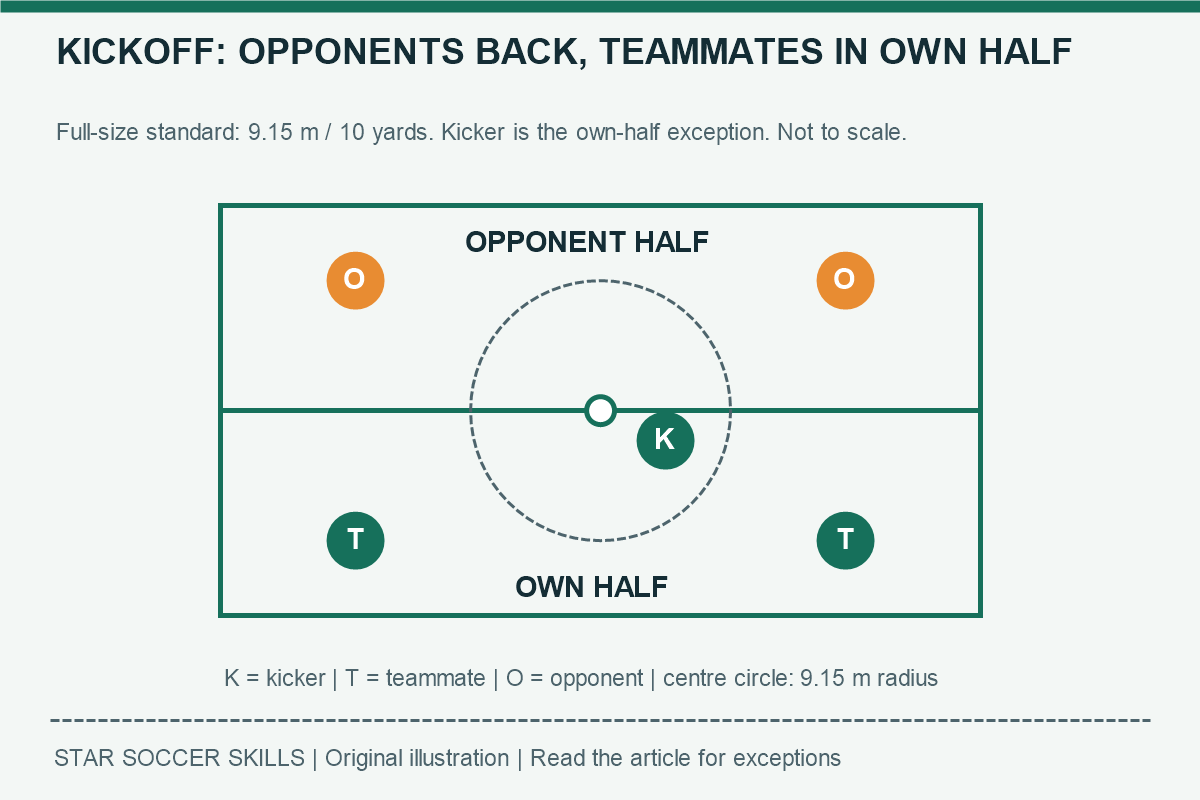
Before the ball is in play, all players except the kicker must be in their own half. That includes the kicker’s teammates. The kicker is the specific exception, allowing a comfortable position to play the ball backward.
Opponents must remain at least 9.15 metres, or 10 yards, from the ball until it is in play. On a standard full-size field, the centre circle marks that distance from the centre mark. Teammates do not share that opponent-distance requirement, but they must obey their own-half positioning rule.
For a smaller youth field, do not copy the full-size centre-circle dimension without checking the approved format. This guide’s standard distance is the adult Law 8 requirement, not a claim that every introductory game uses the same markings.
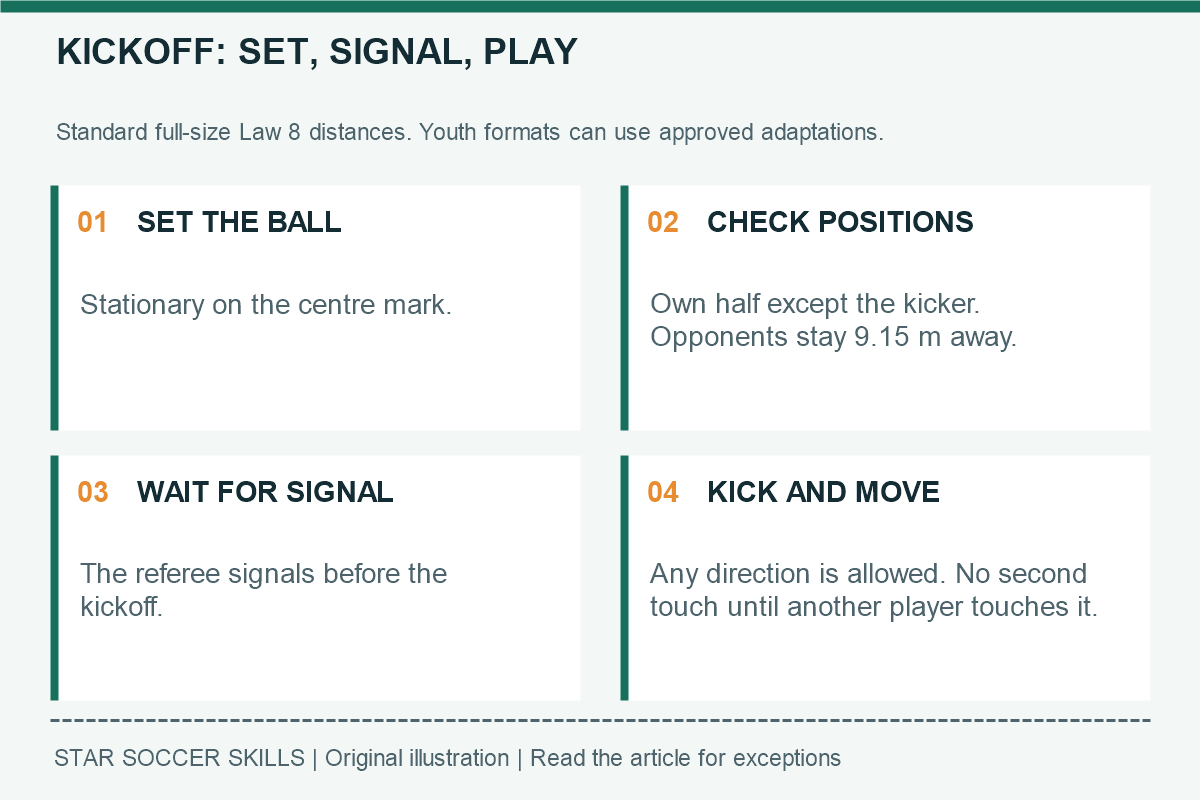
How to take a legal kickoff
- Place the ball stationary on the centre mark.
- Check the other players’ positions and the opponents’ required distance.
- Wait for the referee’s signal.
- Kick the ball so it clearly moves.
- Do not play it again until another player touches it.
The first touch can be forward, sideways, or backward. A teammate does not have to stand next to the kicker for a two-player kickoff. One player can begin the action with a controlled pass, provided the setup and second-touch restrictions are respected.
A feint or a foot resting on the ball does not by itself put it in play. The referee judges whether it has been kicked and clearly moved. Once it is live, opponents can leave the restricted distance and challenge legally.
Common questions at the centre mark
| Situation | Rule or usual outcome |
|---|---|
| The first pass travels backward | Allowed; forward movement is not required |
| A teammate stands in the opponents’ half before the kick | Positioning requirement is not met; the kicker alone has the exception |
| An opponent stands inside the required distance before the kick | Opponent must move back before the restart |
| The kicker takes a second touch before any other player touches it | Normally an indirect free kick; handball has separate provisions |
| The kickoff goes straight into the opponents’ goal | A direct goal can count |
| The kickoff goes straight into the kicker’s own goal | No own goal; opponents receive a corner |
| A different kickoff procedure offence occurs | Law 8 provides a retake |
Can you score directly from kickoff?
Yes, directly against the opponents. A legal kickoff that enters their goal without another touch can score. That is different from a throw-in, from which a direct goal cannot be scored.
If the kickoff travels directly into the kicker’s own goal without another player’s touch, it is not an own goal; the opponents receive a corner. Once another player touches the ball, the direct-restart exception is no longer the same situation, and the usual scoring rules must be considered.
This is a rule explanation, not a recommendation to attempt a long shot in a beginner session. Practice passes at an age-appropriate pace in a safe area, rather than shooting toward an unprepared goalkeeper or other people.
Why the kicker cannot dribble away immediately
The kickoff taker cannot touch the ball again until another player has touched it. A player cannot tap the ball, then take another dribbling touch before anyone else becomes involved. The normal restart for that second touch is an indirect free kick.
If the second action is a handball offence, the law specifies a direct-free-kick response rather than treating it as an ordinary foot-only double touch. A referee’s contact is not automatically another player’s touch. The safest beginner habit is simple: make the first pass, then let a teammate play.
Build that combination through our passing lesson and teamwork lesson. Focus on a clear receiving option rather than memorizing a complicated kickoff routine.
Video: kickoff basics
Soccer Kickoff Rules by Understand Soccer is an external introduction. Use the written IFAB sources below for the current requirements and any disputed decision. A short demonstration may not explain every exception or the competition modifications in a youth match.
Frequently asked questions
Do two players have to take the kickoff?
No. One kicker can put the ball in play. Another player must touch it before that kicker plays it again, but the second player does not have to stand alongside the kicker.
Does the ball have to leave the centre circle?
No. It is in play when kicked and clearly moving. The centre circle controls opponent distance before that moment; it is not a zone the ball must leave.
Can every teammate stand beside the kicker?
They must remain in their own half before the ball is in play. The kicker is the exception. Opponents also have the separate distance requirement.
Official sources
Primary source: IFAB Law 8: The Start and Restart of Play. For free-kick consequences, see Law 13. Check the official law editions and your competition’s approved rules. This guide uses original explanations and illustrations.
Related guides
Continue with these related topics from our beginner soccer library. New guides in this group will become available as they are published.
Leave a Reply