What Is Stoppage Time, and How Is Extra Time Calculated?
Why does the soccer match clock keep running after 90 minutes? A match is 90 minutes of play, but the ball moves for only part of that time.
Referee decisions set how many lost minutes come back as stoppage time, also called added time or injury time. Dead time is any moment the ball is not in play, such as a substitution, injury, or goal celebration.
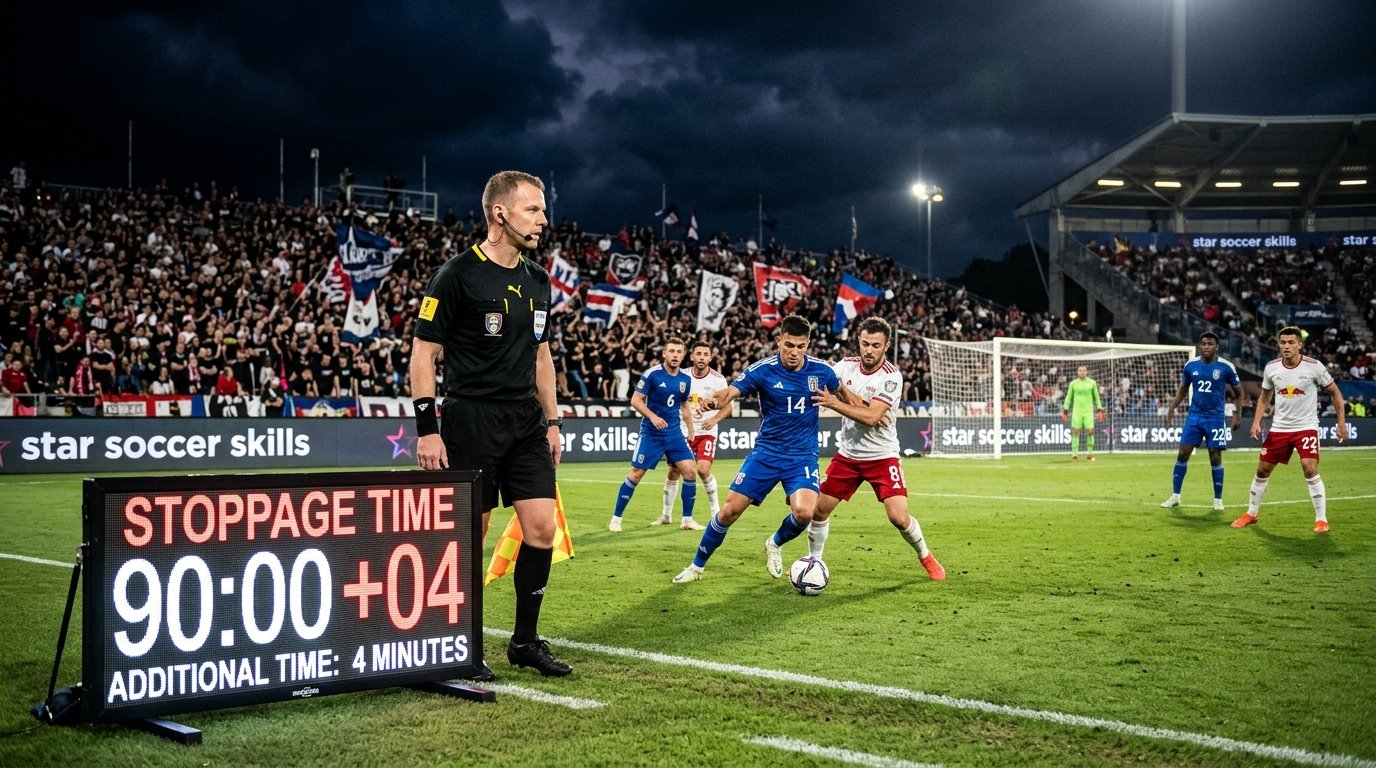
Extra time is different. It is a separate 30-minute period, played only when a knockout match is tied after 90 minutes.
Fans watching a match often mix up these two terms. Below, we explain how the minutes are counted and how extra time works.
Key Takeaways
- A match is 90 minutes of play, but the clock keeps running through pauses.
- Stoppage time is the referee’s added minutes at the end of each half.
- Extra time is two 15-minute periods in knockout matches tied after 90 minutes.
- Stoppage time can also apply at the end of each extra time period.
- The fourth official shows the added minutes for each half.
Stoppage time and extra time are different things, and mixing them up is the most common source of confusion on match day.
How Is Stoppage Time Determined in Soccer?
Stoppage time in soccer is calculated by adding up every pause in play during the half. The referee keeps a running tally and turns it into one number at the end.
The usual end-of-half figure on the board is three to five minutes. Pauses such as a long injury or a VAR review can push the number much higher.
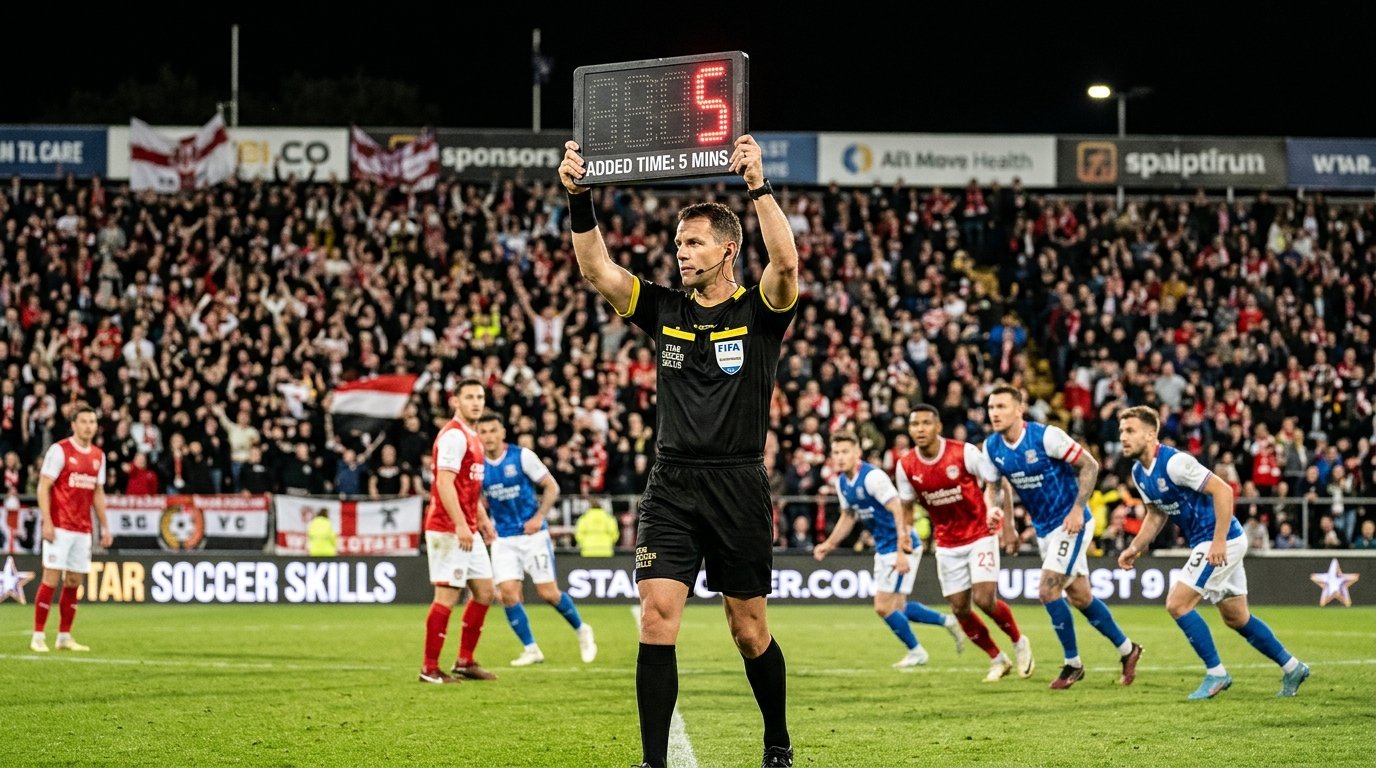
Once the fourth official shows the added minutes, the referee cannot reduce them.
What the Referee Counts
The referee counts every stoppage that takes the ball out of play. The main items are:
- Substitutions
- Injuries, including the time medical staff need to reach a player
- Goal celebrations
- VAR reviews
- Hydration breaks
- Deliberate time wasting
A substitution must be finished within ten seconds of the signal. If it is not, the substitute waits until the first stoppage after one minute has passed.
How the Fourth Official Shows the Number
The fourth official holds up the electronic board that displays the added minutes for the half. The board usually appears in the final minutes, so fans in the stands and at home can see the number.
Why the Final Whistle Can Come Later
There is no fixed cap on added minutes, so a serious injury can add many more than the board shows. Stoppages during added time also add minutes, which means injury time can grow after the number is shown.
Check the board when a half reaches its final minute. A number that rises after the board appears means a new stoppage has occurred.
Why Stoppage Time Can Run Longer Than Expected
A five-minute board figure does not guarantee five minutes of play, because stoppages can happen inside the added time itself. Pauses that start after the board appears push the match clock past the posted number.
Each new pause adds its own minutes, so the final whistle can come well after the board number runs out.
Stoppages Inside Stoppage Time
Stoppage time during stoppage time happens when a new pause begins after the board shows its number. Injury time, substitutions, and other pauses can all stretch the total. Situations that stretch added time include:
- A player injured early in the added minutes
- A VAR check
- A delayed substitution
- A time-wasting card
- A hydration break
Say a player is hurt in the first seconds of a five-minute addition, and treatment takes five minutes. The clock still runs the full five minutes, so almost no live play may happen after the injury.
Records for Longest Added Time
The record for the longest added time in a professional match is 28 minutes. It came in a 2019 Carabao Cup game between Burton Albion and Bournemouth, after an electrical failure.
The longest added time at a World Cup is 24 minutes, in England vs Iran in 2022. World Cup hydration breaks last three minutes each, so every half includes at least three minutes of added time.
Expect added time to run long in a match with several VAR checks, since each one is added to the total.
How Is Extra Time Calculated in Knockout Matches?
Extra time in football is a fixed 30-minute period, not a count of lost minutes. It is played only when a knockout match is level after 90 minutes. They calculate it as two equal 15-minute periods, added on top of the regular match.
A level score after 120 minutes goes to a penalty shootout. A standard match is 90 minutes, so a full knockout game with extra time runs 120 minutes plus added time.
| Part | What it is | When it is played | Length | Who decides the length |
|---|---|---|---|---|
| Regular time | The 90-minute match in two 45-minute halves | In every match | 90 minutes | The match rules |
| Stoppage time | Added minutes for pauses in play | At the end of each half | Usually three to five minutes | The referee |
| Extra time | Two 15-minute periods after a tied knockout match | Only in knockout matches level after 90 minutes | 30 minutes, plus stoppage time | The match format |
| Penalty shootout | Kicks from the penalty spot | Only if still level after 120 minutes | Ends when a winner is found | The match format |
Length of Each Extra Time Period
Each extra time period lasts 15 minutes. Stoppage time still applies at the end of each period if delays happen. The main difference in stoppage time vs extra time in soccer is that one depends on delays and the other is fixed.
What Happens If the Score Is Still Level
If the score is still level after extra time, the match goes to a penalty shootout. Extra time is played only in knockout rounds or competitions that need a winner.
Stoppage Time Inside Extra Time
A penalty kick awarded just before the end of a half extends that half until the kick is complete. The same rule applies to a penalty kick in either 15-minute extra time period. Added time can be shown at the end of each period, just as it is in regular time.
Check whether a match uses extra time before kickoff, since group-stage games end level and do not play it.
How Stoppage Time and Extra Time Affect Betting Markets
A regular-time soccer bet usually settles on the 90 minutes plus the stoppage time the referee adds, and not on extra time. Extra time, which is two 15-minute periods, is generally excluded from regular-time outcomes. Most soccer betting markets follow this pattern.
Extra time goals do not count in a regular-time market.
What Counts in a Regular-Time Bet
A regular-time market counts the full 90 minutes of play. It also counts the stoppage time the referee adds at the end of each half. Any goal scored during that added time counts too.
What Stays Out of a Regular-Time Bet
Penalty shootouts stay out of a regular-time market, because they are not part of play in the 90 minutes. Read the bet terms of the platform you use before placing a wager, since each one sets its own exact rules.
Confirm the market name before betting, since “to win” and “to win in regulation” can settle differently in a knockout game.
Conclusion
Stoppage time follows the referee’s count, while extra time follows the match format. Stoppage time is the added minutes at the end of each half. Extra time is a fixed 30-minute period in knockout matches that are level after 90 minutes.
Knowing both helps fans follow the clock with confidence. Before kickoff, check the match format, and at the end of each half, check the board.