How Many Ballon d’Or Awards Does Messi Have? All 8 Wins
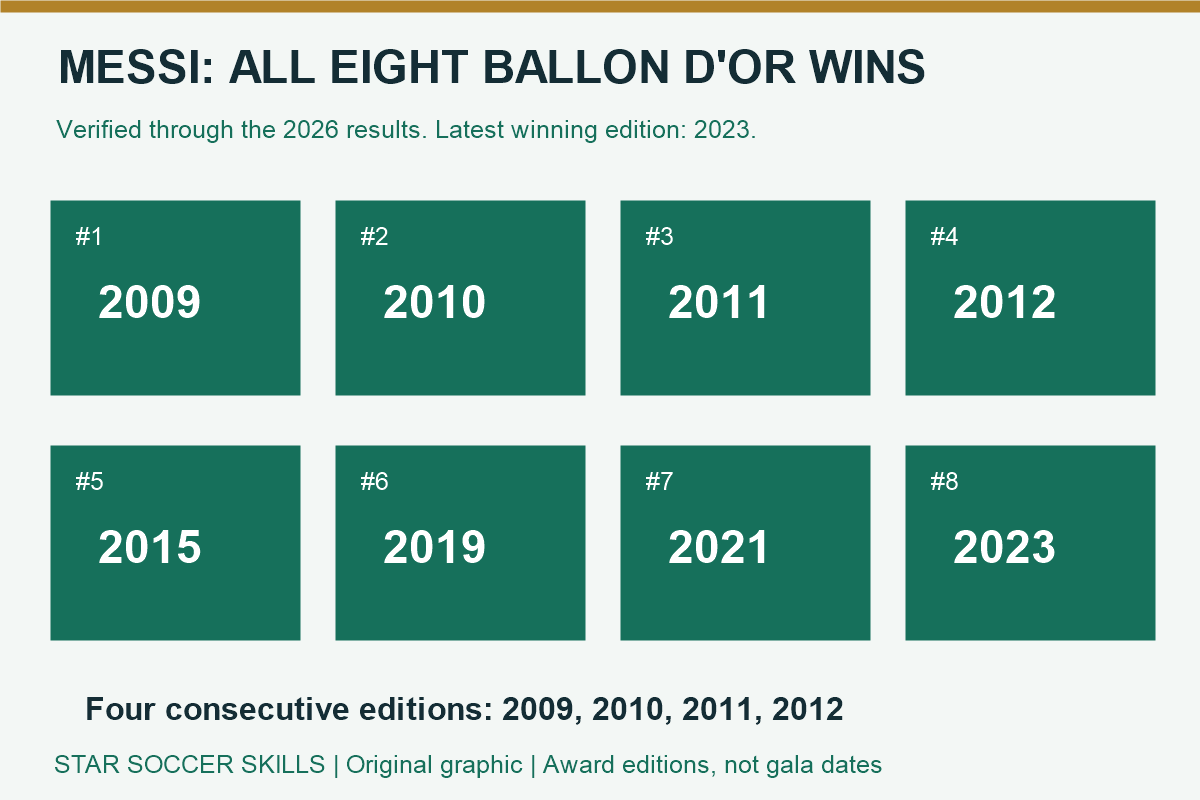
Lionel Messi has won eight Ballon d’Or awards: 2009, 2010, 2011, 2012, 2015, 2019, 2021, and 2023. That is the men’s record, three more than Cristiano Ronaldo’s five. Messi’s most recent winning edition remains 2023 through the confirmed 2026 results.
Eight is the short answer. The more interesting story is how he reached it: four consecutive wins, a return to the top in 2015, a record-breaking sixth in 2019, and two later awards that extended his lead.
This guide walks through every one of Messi’s winning years, explains why older articles and videos say six or seven, and puts his record beside every other men’s winner. You will also find an original timeline, a comparison graph, all the award editions from 1956 onward, and three videos showing the progression to eight.
Record checked against official winners lists through the 2026 edition. Tables use award years, which are not necessarily the calendar year of the presentation ceremony. Archive photographs are labeled; they are not ceremony photographs.
Jump to: Messi’s eight wins · Messi vs. Ronaldo · All winners by total · Every year, 1956–2026 · Three videos · FAQs.
How many Ballon d’Or awards does Messi have? All eight winning years
Messi’s count is eight separate winning editions, not eight nominations or eight player-of-the-year awards from different organizations. The table below counts the competitive men’s Ballon d’Or series once per winning year.
| Award year | Running total | Club in awards list | Record milestone |
|---|---|---|---|
| 2009 | 1 | Barcelona | First win |
| 2010 | 2 | Barcelona | Second; consecutive with 2009 |
| 2011 | 3 | Barcelona | Third consecutive winning edition |
| 2012 | 4 | Barcelona | Fourth consecutive winning edition |
| 2015 | 5 | Barcelona | Fifth win |
| 2019 | 6 | Barcelona | Sixth win; moves ahead of Cristiano Ronaldo |
| 2021 | 7 | Paris Saint-Germain | Seventh win |
| 2023 | 8 | Inter Miami | Eighth and latest winning edition |
The winning years and club labels follow UEFA’s official Ballon d’Or laureates list. A club label identifies the player in the awards record; it should not be read as a claim that every performance considered happened at that club. This matters particularly when a player moves during the period covered.
2009–2012: four consecutive winning editions
Messi’s first award came in 2009. Winning again in 2010, 2011, and 2012 took him from a first-time winner to a four-time winner without another player interrupting the sequence.
That run is a distinctive part of his record. It is not simply four wins somewhere in a long career: they occupy four neighboring editions. In the complete men’s history below, no other player has four consecutive winning award years.
2015 and 2019: five becomes a record six
His 2015 award was number five. By the end of 2017, Cristiano Ronaldo also had five. Messi’s next win, in 2019, moved him ahead again with six.
This is why a video titled “Messi’s six Ballon d’Or triumphs” can be accurate historical footage without being an accurate answer to today’s total. It describes the record at that point, not the end of his award history.
2021 and 2023: the seventh and eighth awards
The 2021 award extended his total to seven. The 2023 edition made it eight, the number used in this article.
There was no additional Messi win in 2024, 2025, or 2026. Those men’s editions went to Rodri, Ousmane Dembélé, and Harry Kane respectively. A new awards ceremony does not automatically change Messi’s count.
Why do some pages say Messi has six, seven, or nine?
Most confusion comes from mixing publication dates, award names, and different competitions. Before trusting a total, check exactly what is being counted.
Six and seven can be older, once-correct totals
Six was correct after the 2019 award. Seven was correct after the 2021 award. Eight became the correct total after 2023. A retrospective clip does not become false because another win happened later, but it needs a date beside it.
The FIFA Ballon d’Or years still belong in the same count
The FIFA Archives’ Ballon d’Or collection identifies the 2010–2015 editions under the FIFA Ballon d’Or name. Messi’s wins in 2010, 2011, 2012, and 2015 are part of his eight, not extra awards to add on top.
UEFA’s historical winners record lists those editions in the same sequence as 2009, 2019, 2021, and 2023. Renaming a trophy during its history does not give a player two wins for one edition.
Other individual awards do not create a ninth Ballon d’Or
A World Cup Golden Ball and a FIFA player-of-the-year award are different distinctions. Winning another prestigious trophy does not increase a Ballon d’Or total.
If you see a claim that Messi has nine, look for a ninth winning edition in the official record. Through the 2026 results, there is none. Our guide to what the Ballon d’Or is explains the award itself, while this page focuses on Messi’s count and the historical comparison.
2020 was canceled, not awarded to an unofficial winner
No men’s Ballon d’Or was awarded for 2020. A fan’s view of who should have won cannot be inserted into the winners list as an official result. That is why the chronological table keeps the year visible but adds no trophy to any player’s total.
Messi vs. Cristiano Ronaldo: eight awards against five
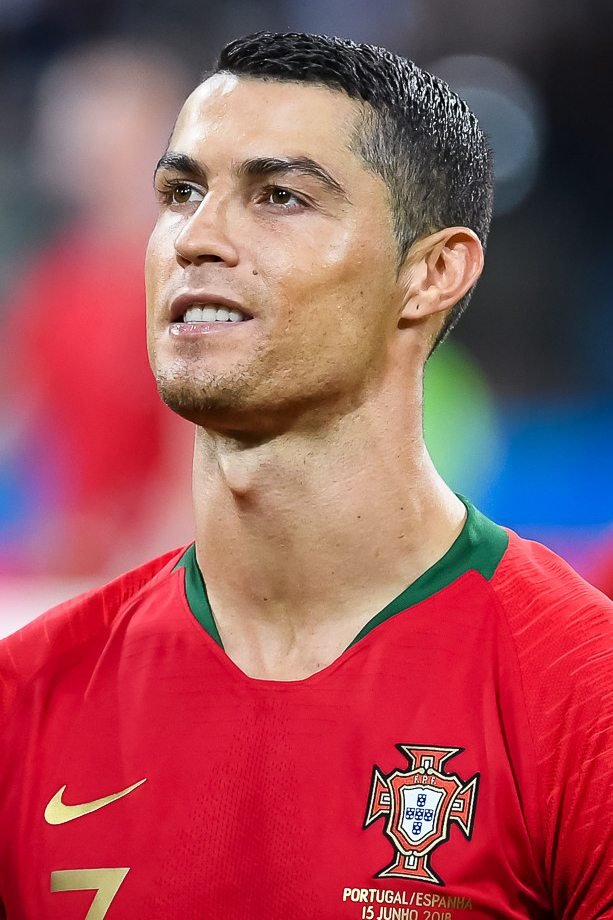
Messi leads Cristiano Ronaldo by three men’s Ballon d’Or awards. Together, they account for 13 winning editions. Between 2008 and 2017 inclusive, every edition went to one of the two.
| Player | Wins | Award years |
|---|---|---|
| Lionel Messi | 8 | 2009, 2010, 2011, 2012, 2015, 2019, 2021, 2023 |
| Cristiano Ronaldo | 5 | 2008, 2013, 2014, 2016, 2017 |
Important name distinction: Cristiano Ronaldo is not the same player as Brazil’s Ronaldo, who won in 1997 and 2002. The complete comparison table separates them so their totals are never accidentally combined.
If you want to compare more than award counts, see our Messi vs. Ronaldo career comparison. Keep the date and definition of each statistic in view: an award total, a goals total, and a trophy count answer different questions.
Every men’s Ballon d’Or winner, ranked by total wins
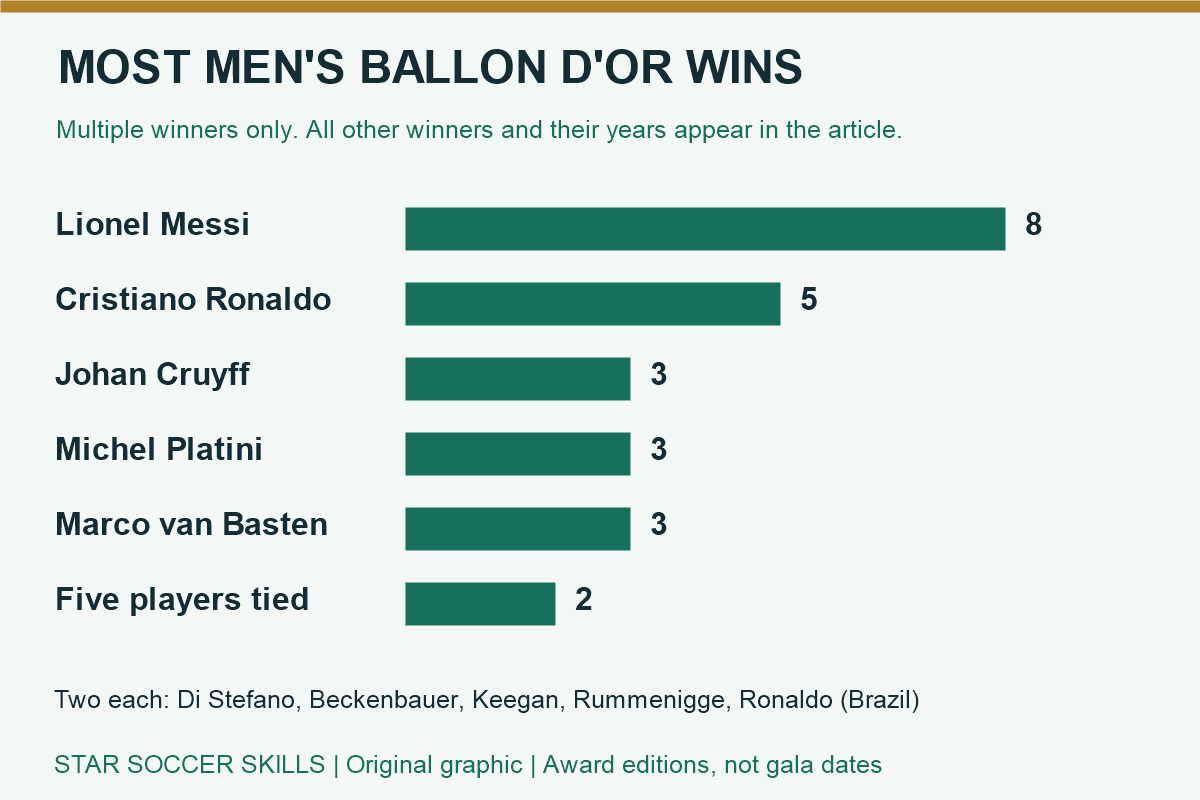
Messi comes first because he has the most wins. Cristiano Ronaldo follows with five, then Johan Cruyff, Michel Platini, and Marco van Basten with three each. Five players have two awards; the remaining winners have one each.
The graph summarizes the multiple winners. The table underneath includes every men’s winner and all their winning years through 2026. Equal totals are ties, not a judgment that one tied player was better; within each total, players are ordered by their first winning year.
| Player | Wins | All winning award years |
|---|---|---|
| Lionel Messi | 8 | 2009, 2010, 2011, 2012, 2015, 2019, 2021, 2023 |
| Cristiano Ronaldo | 5 | 2008, 2013, 2014, 2016, 2017 |
| Johan Cruyff | 3 | 1971, 1973, 1974 |
| Michel Platini | 3 | 1983, 1984, 1985 |
| Marco van Basten | 3 | 1988, 1989, 1992 |
| Alfredo Di Stéfano | 2 | 1957, 1959 |
| Franz Beckenbauer | 2 | 1972, 1976 |
| Kevin Keegan | 2 | 1978, 1979 |
| Karl-Heinz Rummenigge | 2 | 1980, 1981 |
| Ronaldo (Brazil) | 2 | 1997, 2002 |
| Stanley Matthews | 1 | 1956 |
| Raymond Kopa | 1 | 1958 |
| Luis Suárez | 1 | 1960 |
| Omar Sívori | 1 | 1961 |
| Josef Masopust | 1 | 1962 |
| Lev Yashin | 1 | 1963 |
| Denis Law | 1 | 1964 |
| Eusébio | 1 | 1965 |
| Bobby Charlton | 1 | 1966 |
| Flórián Albert | 1 | 1967 |
| George Best | 1 | 1968 |
| Gianni Rivera | 1 | 1969 |
| Gerd Müller | 1 | 1970 |
| Oleh Blokhin | 1 | 1975 |
| Allan Simonsen | 1 | 1977 |
| Paolo Rossi | 1 | 1982 |
| Ihor Belanov | 1 | 1986 |
| Ruud Gullit | 1 | 1987 |
| Lothar Matthäus | 1 | 1990 |
| Jean-Pierre Papin | 1 | 1991 |
| Roberto Baggio | 1 | 1993 |
| Hristo Stoichkov | 1 | 1994 |
| George Weah | 1 | 1995 |
| Matthias Sammer | 1 | 1996 |
| Zinédine Zidane | 1 | 1998 |
| Rivaldo | 1 | 1999 |
| Luís Figo | 1 | 2000 |
| Michael Owen | 1 | 2001 |
| Pavel Nedvěd | 1 | 2003 |
| Andriy Shevchenko | 1 | 2004 |
| Ronaldinho | 1 | 2005 |
| Fabio Cannavaro | 1 | 2006 |
| Kaká | 1 | 2007 |
| Luka Modrić | 1 | 2018 |
| Karim Benzema | 1 | 2022 |
| Rodri | 1 | 2024 |
| Ousmane Dembélé | 1 | 2025 |
| Harry Kane | 1 | 2026 |
All counts above are calculated from the year-by-year record, rather than assembled from different career profiles with different update dates. That makes the comparison checkable: a player’s listed years must add up to the number in the wins column.
Ballon d’Or winners by award year: 1956–2026
Use this table to look up an individual edition. It contains every award year from 1956 to 2026, including the canceled 2020 edition. These 71 year labels correspond to 70 awarded men’s editions.
Award year versus ceremony date: a gala can take place after the year printed on the award. The rows below identify the official award edition, not an asserted day or calendar year of a live ceremony. No presentation dates have been guessed.
| Award year | Winner or status |
|---|---|
| 1956 | Stanley Matthews |
| 1957 | Alfredo Di Stéfano |
| 1958 | Raymond Kopa |
| 1959 | Alfredo Di Stéfano |
| 1960 | Luis Suárez |
| 1961 | Omar Sívori |
| 1962 | Josef Masopust |
| 1963 | Lev Yashin |
| 1964 | Denis Law |
| 1965 | Eusébio |
| 1966 | Bobby Charlton |
| 1967 | Flórián Albert |
| 1968 | George Best |
| 1969 | Gianni Rivera |
| 1970 | Gerd Müller |
| 1971 | Johan Cruyff |
| 1972 | Franz Beckenbauer |
| 1973 | Johan Cruyff |
| 1974 | Johan Cruyff |
| 1975 | Oleh Blokhin |
| 1976 | Franz Beckenbauer |
| 1977 | Allan Simonsen |
| 1978 | Kevin Keegan |
| 1979 | Kevin Keegan |
| 1980 | Karl-Heinz Rummenigge |
| 1981 | Karl-Heinz Rummenigge |
| 1982 | Paolo Rossi |
| 1983 | Michel Platini |
| 1984 | Michel Platini |
| 1985 | Michel Platini |
| 1986 | Ihor Belanov |
| 1987 | Ruud Gullit |
| 1988 | Marco van Basten |
| 1989 | Marco van Basten |
| 1990 | Lothar Matthäus |
| 1991 | Jean-Pierre Papin |
| 1992 | Marco van Basten |
| 1993 | Roberto Baggio |
| 1994 | Hristo Stoichkov |
| 1995 | George Weah |
| 1996 | Matthias Sammer |
| 1997 | Ronaldo (Brazil) |
| 1998 | Zinédine Zidane |
| 1999 | Rivaldo |
| 2000 | Luís Figo |
| 2001 | Michael Owen |
| 2002 | Ronaldo (Brazil) |
| 2003 | Pavel Nedvěd |
| 2004 | Andriy Shevchenko |
| 2005 | Ronaldinho |
| 2006 | Fabio Cannavaro |
| 2007 | Kaká |
| 2008 | Cristiano Ronaldo |
| 2009 | Lionel Messi |
| 2010 | Lionel Messi |
| 2011 | Lionel Messi |
| 2012 | Lionel Messi |
| 2013 | Cristiano Ronaldo |
| 2014 | Cristiano Ronaldo |
| 2015 | Lionel Messi |
| 2016 | Cristiano Ronaldo |
| 2017 | Cristiano Ronaldo |
| 2018 | Luka Modrić |
| 2019 | Lionel Messi |
| 2020 | Canceled — no award presented |
| 2021 | Lionel Messi |
| 2022 | Karim Benzema |
| 2023 | Lionel Messi |
| 2024 | Rodri |
| 2025 | Ousmane Dembélé |
| 2026 | Harry Kane |
Source: UEFA’s year-by-year Ballon d’Or history. The two tables show the same results in different ways: grouped by player for comparisons, and ordered by year for lookups.
Does the most Ballon d’Or wins make Messi the best ever?
It makes him the most decorated player in the men’s Ballon d’Or record. Calling him the greatest soccer player of all time is an interpretation, not a separate fact established by adding trophies.
For Messi supporters, eight awards are a powerful part of the argument: repeated recognition over a long span, not just one outstanding campaign. But an honest comparison also considers roles, the competitions available in different eras, and how an award’s rules have changed.
A goalkeeper, a defender, and an attacking playmaker do not contribute in identical ways. Nor does a list of winners tell you how close the voting was in each edition. The graph deliberately shows wins, not an invented percentage of “greatness.”
That does not diminish Messi’s achievement. It states it precisely: eight winning editions, the highest men’s total through 2026, and a four-edition winning sequence that no other men’s winner matches.
Three videos: Messi’s journey from six awards to eight
These original-provider videos create a chronological viewing sequence. The first stops at six, the second marks seven, and the third covers eight. Their titles reflect the period they were produced, not three competing claims about the current record.
1. Relive Messi’s first six Ballon d’Or wins
FC Barcelona’s retrospective is useful for the Barcelona chapter of the record, ending with the 2019 sixth award. It is historical viewing, not a current total.
2. Messi wins his seventh in 2021
This FC Barcelona video marks the 2021 seventh award. The uploader’s identity does not mean Messi was still a Barcelona player when the award was presented; the official winners list identifies Paris Saint-Germain for that edition.
3. Messi wins his eighth in 2023
CBS Sports Golazo’s coverage marks the eighth award. This is broadcaster coverage from the original channel, not a fan re-upload or an AI-dubbed speech.
Videos are embedded from YouTube, with direct watch links if a player is unavailable. Access can vary with region, consent settings, or provider restrictions. No broadcasts have been downloaded or re-uploaded.
What about the latest ceremony and the women’s Ballon d’Or?
The 2026 men’s winner was Harry Kane. Alexia Putellas won the women’s award, her third. The women’s Ballon d’Or is a separate series, introduced in 2018; its winners are not added to the men’s totals above.
For the latest full rankings and all the supporting categories, continue to our Ballon d’Or 2026 winners and ceremony guide. That guide is a separate news roundup; this page is an evergreen explanation of Messi’s record.
One useful way to watch Messi beyond the awards
When you watch match footage, notice the touch before the pass or shot. Ask what it changes: the angle, the distance from an opponent, or the time available for the next action. That observation can make a famous player’s highlights more interesting than a trophy count alone.
A beginner does not need to copy a professional workload. Start with a manageable skill in a safe space; our first-touch lesson offers a practical starting point. Awards can inspire attention, but they are not a training plan or a promise of future success.
Frequently asked questions
How many Ballon d’Or awards does Messi have?
Lionel Messi has eight, the men’s record through the 2026 edition.
Which years did Messi win the Ballon d’Or?
He won in 2009, 2010, 2011, 2012, 2015, 2019, 2021, and 2023.
When was Messi’s last Ballon d’Or win?
His latest winning edition is 2023. He did not win the 2024, 2025, or 2026 men’s award.
Did Messi win four Ballon d’Or awards in a row?
Yes. He won four consecutive award editions: 2009, 2010, 2011, and 2012.
How many more does Messi have than Cristiano Ronaldo?
Three more: Messi has eight and Cristiano Ronaldo has five.
Does Messi have eight or nine Ballon d’Or awards?
Eight. Other individual prizes do not count as extra Ballon d’Or wins, and no ninth winning edition appears in the official list through 2026.
Who won the Ballon d’Or in 2020?
Nobody. The award was canceled, so the year contributes no win to any player’s official total.
Are the FIFA Ballon d’Or awards included?
Yes. Messi’s wins during the combined-name period belong in the eight-edition total; they are not counted a second time.
The answer to remember
Messi has eight Ballon d’Or awards. Remember the sequence as four in a row—2009 to 2012—followed by 2015, 2019, 2021, and 2023. Cristiano Ronaldo is next on five. The tables above provide the full historical record without mixing awards, guessing ceremony dates, or turning opinions into results.
Leave a Reply