Soccer Substitution Rules: Youth Leagues vs. Professional Matches
Soccer substitution rules depend on both the Laws of the Game and the competition’s regulations. “Five substitutes” is not a universal rule for every match, and it does not mean five separate opportunities to stop play and make a change. Youth return substitutions, extra time, and concussion protocols need their own checks.
Rules check: this article was checked against IFAB’s 2026/27 Laws on October 29, 2026. It includes the current ten-second exit procedure. Always check the edition and regulations actually used by your league, school, tournament, or association. Our soccer basics lesson introduces the team and field before these procedural details.
How many substitutions can a team make?
In official competitions, the relevant governing body determines the permitted number under Law 3, ordinarily up to five. Many top-level competitions use five, but a specific event can use a different permitted setup. The number of players named on the bench is also different from the number who may enter.
For the top-division first-team and senior international official-competition framework allowing five substitutes, each team has a maximum of three substitution opportunities during play, plus half-time changes. Multiple substitutions at the same stoppage count as one opportunity. A simultaneous change by both teams counts for each.
Read the match rules before selecting the squad or promising someone a return to the field. A bench with several unused players does not create extra opportunities once the permitted windows are used.
Youth leagues versus professional matches
| Issue | Common top-level framework | Youth and grassroots consideration |
|---|---|---|
| Number of substitutes used | Often five, subject to event regulations | Check the specific approved competition rules |
| Opportunities during play | Three in the specified five-substitute framework | Do not assume the same window system applies |
| Returning after being replaced | Normally not allowed under standard non-return rules | Return substitutions may be authorized |
| Extra-time addition | Only if competition regulations permit it | Check whether extra time is played at all |
| Concussion replacement | Separate protocol if adopted | Medical and safeguarding procedures still come first |
| Procedure and permission | Referee-controlled entry and exit | Follow approved modifications and the referee’s instructions |
The normal substitution procedure
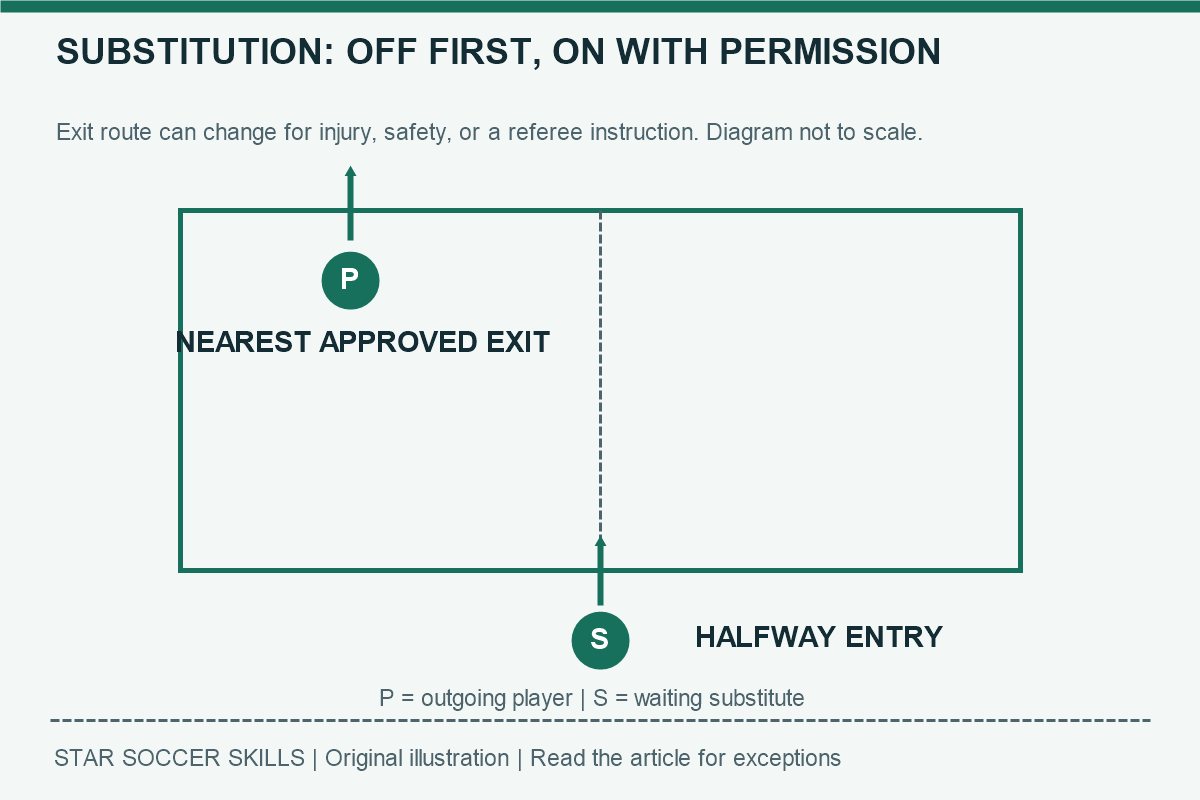
Substitutes must be named to the referee before the match. The referee must be informed before a substitution. The outgoing player leaves with permission, ordinarily by the nearest boundary point unless the referee directs otherwise for a reason such as injury, safety, or security.
The incoming substitute enters during a stoppage, at the halfway line, after the outgoing player has left and after the referee’s signal. Being listed on the board does not itself authorize entry. The change is complete when the substitute enters; the incoming player can then take a restart.
The outgoing player normally goes to the technical area or dressing room and takes no further part unless return substitutions are allowed. A replaced player remains subject to the referee’s authority.
The 2026/27 ten-second exit rule
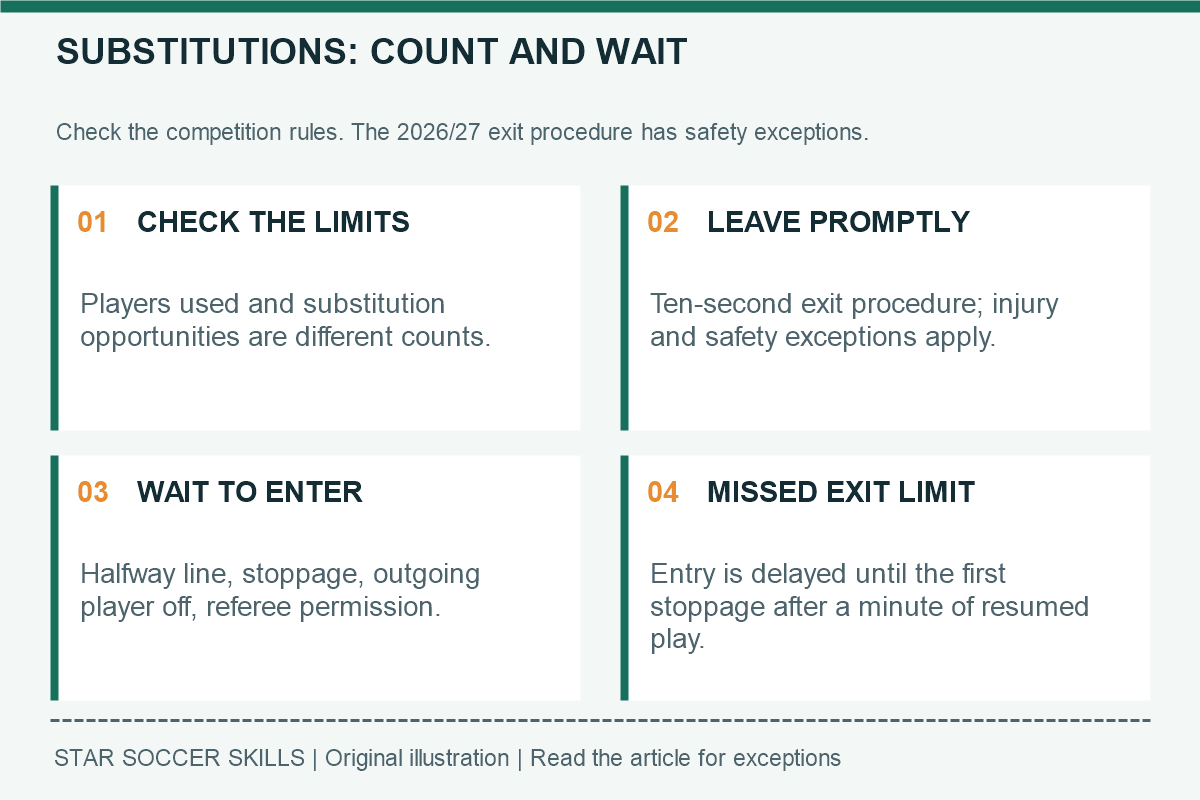
Under the current procedure, the outgoing player must be off the field within ten seconds of the substitution board being displayed, or the referee’s substitution signal if there is no board. Safety, security, and injury exceptions apply.
For multiple changes at the same stoppage, the outgoing players must all leave within ten seconds of the last substitution being indicated. It is not ten seconds to jog toward the bench and then a separate allowance to cross the line.
If the deadline is missed without an applicable exception, the player still leaves, but the substitute cannot enter immediately. Play restarts, and the substitute may enter only with permission at the first stoppage after one minute has elapsed following that restart. The substitution cannot simply be cancelled or switched to a different incoming player.
A caution is not automatic at the ten-second mark. It applies for excessive delay beyond that period. This consequence is separate from a genuine injury or safety problem, which the referee must manage appropriately.
Five players and three opportunities: an example
A team replaces two players at the 60th-minute stoppage, one at the 70th, and two at the 80th. That uses five substitutes and three opportunities. By contrast, one player at each of three stoppages uses the three opportunities while leaving two of the five player changes unused for ordinary in-play windows.
A half-time substitution does not consume one of those three opportunities, although it still counts toward the permitted number of substitutes. This distinction prevents a common mistake: an unused player allowance does not necessarily mean another ordinary substitution window remains.
Extra time and friendly matches
Unused permitted substitutes and opportunities can carry into extra time. If the regulations permit an additional extra-time substitute, the team also receives an additional opportunity. Changes between full-time and extra time, and at extra-time half-time, do not count as used opportunities under the stated framework.
Senior A international friendlies have a different current allowance: up to eight substitutes may be used, or up to eleven if both teams agree and tell the referee beforehand. The substitution-opportunity restrictions apply. Do not repeat the older blanket six-substitute description for these 2026/27 matches.
Other non-official matches have their own Law 3 agreement provisions. A preseason friendly is not automatically governed by the same settings as a league game, and teams should not invent an arrangement after play has begun.
Are return or rolling substitutions allowed?
Return substitutions can be authorized in youth, veterans, disability, and grassroots football with the relevant governing body’s agreement. That does not make them automatic in every youth event. Read whether replaced players may return, when changes can happen, and whether permission or particular restart conditions are required.
Do not treat a practice session’s free rotation as the competition’s substitution rule. Coaches can use inclusive training rotations while still preparing players for the procedures used on match day.
Concussion replacements are a separate issue
Competitions can adopt additional permanent concussion substitutions under the relevant protocol. These are not a general free replacement for any injury, and a normal substitution allowance should never be used to discourage a player from reporting symptoms.
Follow the competition’s medical and concussion procedures and seek appropriate medical support. This rules article does not assess an injury or give return-to-play clearance. An injured child or adult should not be pressured to continue because the team is worried about its remaining substitutes.
Video: current-law changes overview
All the new 2026/2027 IFAB + World Cup laws – Explained by Referee Channel is supplementary viewing. It covers a broader subject than substitutions and may discuss tournament-specific details. Use Law 3 and your own event regulations, not a general video title, to establish the exact procedure.
Frequently asked questions
Can a player sent off after kickoff be replaced?
No. A substitution is not a way to restore a team to full strength after a player is sent off during the match. Pre-kickoff team-list situations have separate provisions.
Does changing the goalkeeper always use a substitute?
No. Two players already on the field can exchange goalkeeper duties during a stoppage if the referee is informed. Bringing someone from the bench into the match is a different situation.
What if the outgoing player refuses to leave?
Law 3 says play continues if the player to be replaced refuses to leave. That is different from completing the substitution or gaining permission for the incoming player to enter anyway.
Official sources and further reading
Primary sources: IFAB Law 3: The Players and the 2026/27 law changes. Check the protocols and competition regulations that apply to your match. For team participation in practice, see our teamwork lesson; for the clock, see our stoppage-time explainer.
Related guides
Continue with these related topics from our beginner soccer library. New guides in this group will become available as they are published.
Leave a Reply