Soccer Tryout Preparation for Beginners: Skills and Checklist
Soccer tryout preparation for beginners should make the day more familiar, not turn the week before it into a last-minute fitness challenge. Learn the event requirements, practice a few comfortable skills, and arrive ready to listen and participate. No routine can guarantee selection.
This guide is a practical checklist rather than a scouting formula. Clubs assess players differently, and the available places, age group, team needs, and development goals affect decisions. Use our step-by-step soccer lessons to build a foundation instead of trying to learn every skill immediately before a trial.
First confirm what the tryout actually involves
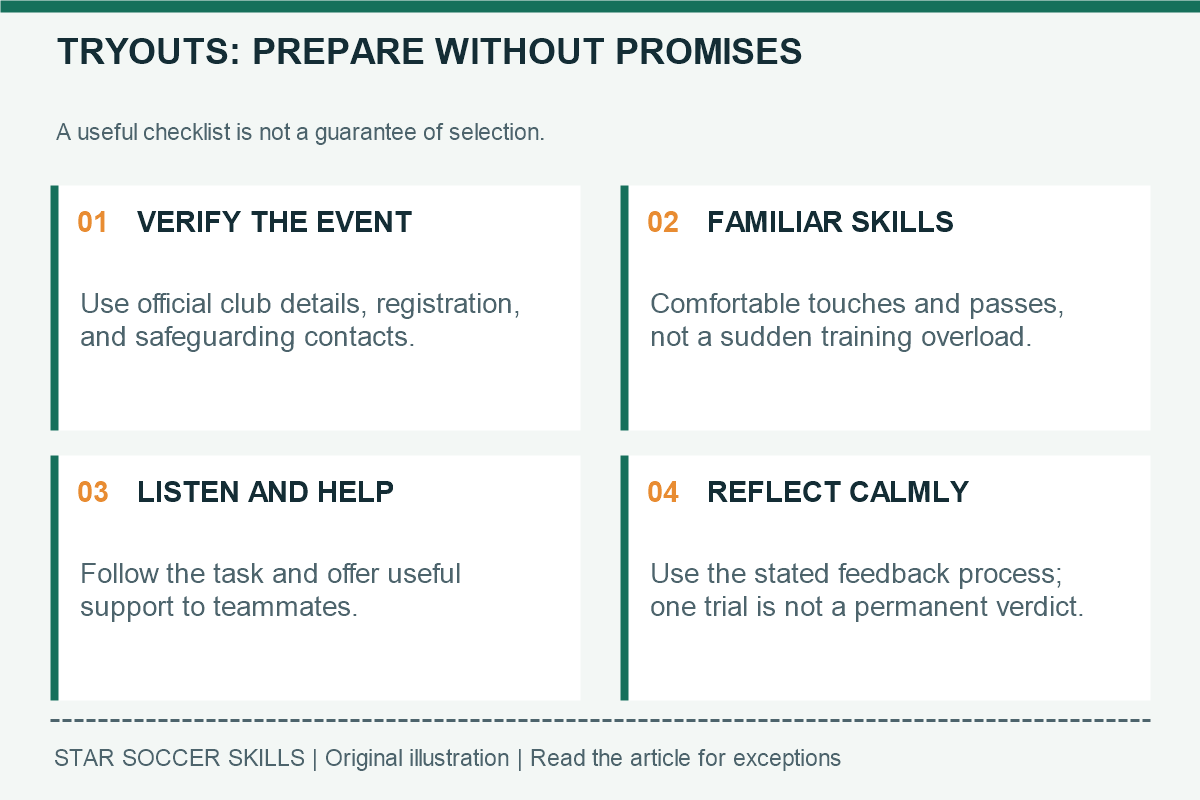
Read the official invitation or contact the organizer. Confirm the age cutoff, registration, location, check-in time, session duration, required equipment, and whether a goalkeeper assessment is separate. Ask about access needs through the club’s normal process.
For a child, a guardian should verify who runs the event, safeguarding and pickup arrangements, and the contact for questions. Do not send sensitive identity or medical details to an unverified person who claims to be a scout. Use official club channels for forms, payments, and information.
Find out whether the session uses individual activities, small games, or a full match. Knowing the format lets you prepare sensibly; it does not mean rehearsing a performance to avoid making any mistake.
A flexible preparation outline
| Stage | Useful action | Avoid |
|---|---|---|
| When you register | Check instructions and ask about the format | Assuming another club’s rules apply |
| In the days before | Short familiar skill practice and normal recovery | Sudden extra conditioning or unfamiliar hard sessions |
| The day before | Pack equipment and confirm travel | Trying to fix every weakness overnight |
| At check-in | Introduce yourself and follow instructions | Entering drills without knowing the setup |
| After the session | Ask about the stated feedback process | Demanding an immediate selection promise |
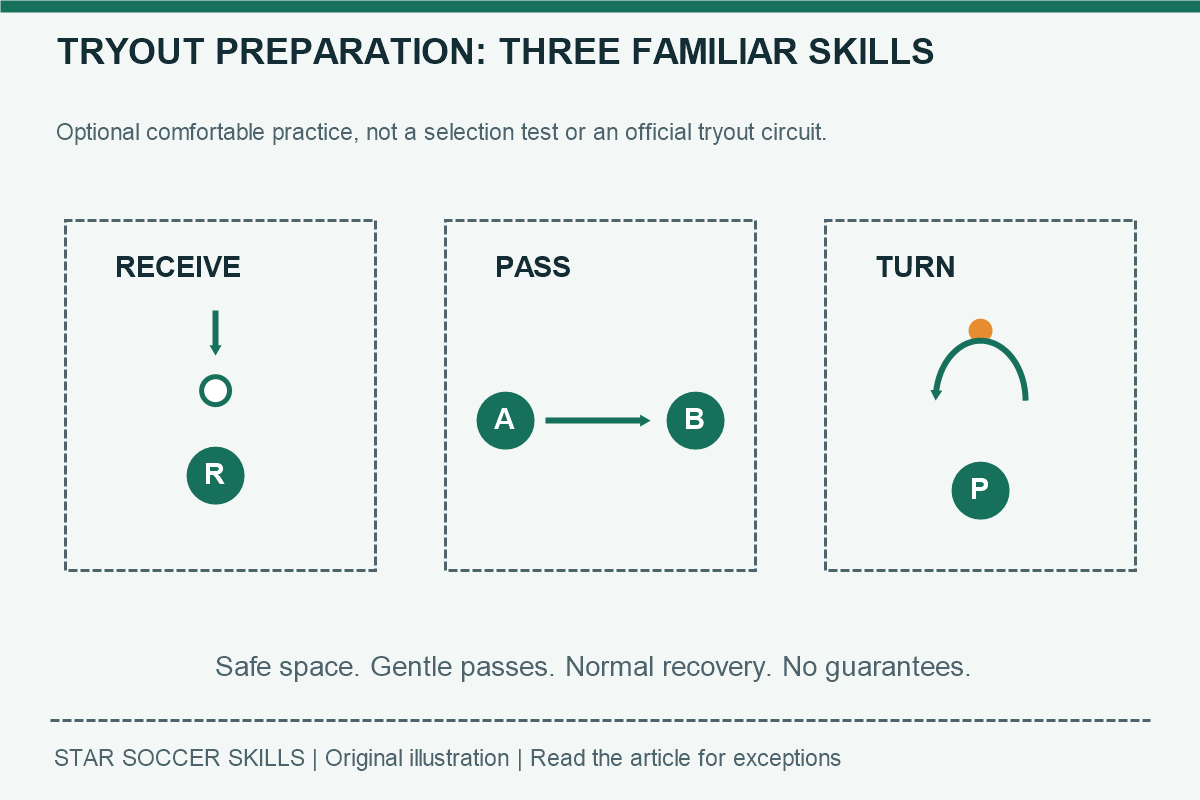
Practice three basics you can use in a game
1. A comfortable first touch
Use gentle partner passes on a safe surface. Adjust your feet as the ball arrives, cushion it into a playable position, and prepare the next pass. Start close enough that both players can succeed without chasing. The first-touch lesson explains the technique.
Do not turn every repetition into a timed test. If the ball keeps escaping, reduce the pass speed. Practicing with both feet can be useful, but a difficult weaker-foot action should not be forced at speed simply because a tryout is approaching.
2. An accurate short pass
Work with a partner or a suitable permitted wall. Look at the target, use the inside of the foot, and deliver a manageable ground pass. Then move into view for the return. Our passing lesson connects technique with a useful receiving angle.
A trial is not won by kicking every pass harder. A sensible ball that helps a teammate play is often more useful than a difficult action chosen only to attract attention.
3. Control while changing direction
In a clear area, dribble slowly between safe markers, stop before the boundary, and turn into open space. Use the dribbling lesson to keep the ball within reach. Add speed only when the surface, space, and control make it suitable.
What to do on tryout day
Arrive according to the organizer’s instructions, with enough time for check-in. Wear the required safe equipment and bring water. Follow normal eating and recovery habits appropriate to you rather than experimenting with supplements or a new routine.
Listen to demonstrations and ask a brief question if the activity is unclear. During play, offer a passing option, communicate respectfully, and respond constructively to an error. You do not need to narrate everything or shout to prove leadership.
If you lose the ball, try a useful next action: recover, support a teammate, or prepare for the restart. Read our teamwork lesson for examples of helping without having possession.
Tell a coach or responsible adult if you feel unwell, hurt, unsafe, or unsure about a physical task. Playing through pain to seem committed is not a sound preparation strategy. Follow the event’s medical and safeguarding procedures.
A simple equipment and information checklist
- Confirmed registration and official organizer contact.
- Venue, arrival time, travel plan, and pickup arrangements.
- Required footwear, shin protection, clothing, and weather-appropriate layers.
- Water and any organizer-requested personal equipment.
- Relevant access or support needs communicated through the appropriate channel.
- Clear understanding of the feedback and selection timeline.
Download the printable beginner tryout checklist (PDF). It contains space to record event details and tick off preparations; it is not an endorsement of a particular club.
Video: a familiar-skill reference
10 EASY Ball Mastery Exercises For Beginners by 7mlc is supplementary technique viewing, not a tryout selection formula. Choose only suitable familiar movements. Do not attempt the full workout at an unfamiliar intensity immediately before an assessment.
After the tryout: use feedback carefully
Thank the organizers and follow the stated feedback process. Record one action that felt comfortable and one you want to practice. A single session cannot measure every aspect of a player, and one club’s decision is not a permanent judgment of potential.
If feedback is available, ask for a specific development suggestion rather than a ranking against other children. Keep personal notes private and do not post another child’s assessment or identifying details online.
Frequently asked questions
Can a complete beginner attend a tryout?
Check whether the event welcomes beginners or expects a particular playing level. Some clubs offer development sessions that may be a better starting point than a selective trial.
Should I train harder the day before?
A sudden hard session is not a shortcut to readiness. Stick with familiar, comfortable preparation and appropriate recovery; ask a qualified professional for individualized guidance if needed.
What if I make a mistake?
Reset and choose a helpful next action. No player controls every touch perfectly. Do not let one error turn into unsafe effort or a negative response toward teammates.
General learning context: FIFA Training Centre grassroots resources. This article is original general preparation guidance; selection criteria come from the event organizer.
Related guides
Continue with these related topics from our beginner soccer library. New guides in this group will become available as they are published.
Leave a Reply