First-Touch Practice Test: Record and Compare Your Progress
A soccer first touch test can help you notice changes in your own practice, but only if you repeat the same task under similar conditions. A score from a different ball, surface, distance, or pass speed does not tell the same story.
This is an original self-comparison activity, not a validated test, talent measure, or age-group benchmark. There is no pass mark. Use our first-touch lesson to learn the technique, then record a simple practice baseline without treating the number as a verdict on ability.
Set up a repeatable, safe receiving task
Use a flat, dry surface with enough clear space around the receiver. A partner sends gentle ground passes from a comfortable distance, such as about four yards for a beginner. Adjust before starting; the useful distance is one at which the partner can deliver a manageable ball consistently.
Mark a receiving zone that gives the player a realistic chance of control. A roughly two-yard-wide area can be a starting suggestion, not a required dimension. Leave extra run-off space and use safe non-slip markers. Do not place the zone near glass, stairs, traffic, or other people.
Choose an age-appropriate ball and suitable footwear. Children need appropriate adult supervision. Stop for pain, dizziness, distress, unsafe footing, or a task that is no longer comfortable. Water and rest are available whenever needed.
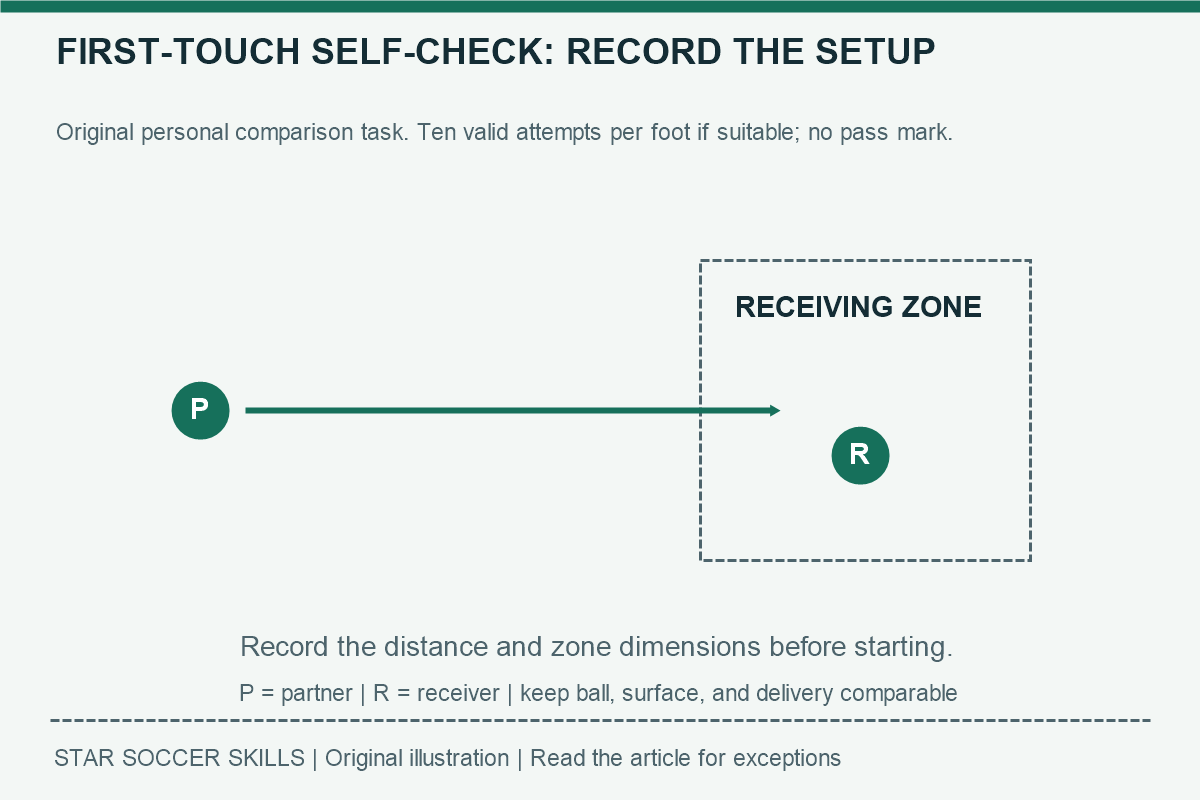
Define a successful attempt before you start
For this version, count an attempt as successful when the first touch leaves the ball inside the chosen zone, within one comfortable step, and the player remains balanced enough to play again. Write that definition on the sheet so it does not change between sessions.
The definition is a practical agreement for your setup, not an official coaching standard. A more experienced player may use a directional target, but changing the target creates a new task. Record a fresh baseline rather than comparing the new score directly with the old one.
If a partner’s pass clearly misses the agreed receiving area or arrives at an unsuitable speed, mark it as an unsuitable delivery and repeat it. Record how many were repeated. Do not quietly discard difficult but valid attempts to improve the score.
The first-touch practice procedure
- Check the area and take a few comfortable familiarization passes that do not count.
- Agree which foot will receive and how the partner will deliver the ball.
- Take ten valid gentle ground passes, pausing between attempts as needed.
- Mark each valid attempt as controlled or not controlled using the same definition.
- Rest, then repeat with the other foot if it is suitable for the player.
- Write one observation about the setup or technique, not just the total.
There is no need to finish both sets if concentration or comfort drops. A shorter recorded set is more honest than forcing ten attempts and pretending the conditions stayed the same. Never compare a five-attempt total directly with a ten-attempt total.
What to write down
| Field | What to record |
|---|---|
| Date and setup label | A way to identify this exact practice version |
| Ball, surface, and footwear | Enough detail to reproduce the conditions |
| Distance and zone dimensions | Use the same measurements next time |
| Delivery | Partner ground pass; note speed and any change of partner |
| Right-foot set | Controlled attempts / valid attempts, plus repeated deliveries |
| Left-foot set | Separate result, not a combined ranking |
| Practice note | One cue or adjustment to explore next time |
Download the printable first-touch record sheet (PDF). It includes setup fields and ten-attempt rows for each foot. Keep it as a private personal practice record.
How to interpret the result
Suppose you control six of ten similar passes in one session and seven in the next. That may be encouraging, but a one-attempt change can also reflect normal variation in delivery, attention, or the surface. Look for a pattern across comparable sessions rather than claiming a precise percentage improvement in ability.
Compare a foot with its own earlier result. Do not assume the two feet must have identical scores, and do not use a friend’s score from a different setup as a standard. The sheet does not predict selection, match performance, or development potential.
Technique observations can be more useful than the total: did you adjust your feet, stay balanced, or prepare the next pass? The passing lesson helps connect a controlled receive to a useful next action.
Change one variable when the task becomes comfortable
After several comfortable sessions, you might add a gentle directional first touch toward a wide gate. Alternatively, keep the same target and use a slightly different pass angle. Change one variable, label the new setup, and establish a new baseline.
Do not simultaneously narrow the target, increase speed, and add pressure. A self-check should remain understandable. Game decisions still need game-related practice, such as the small-sided games lesson; a controlled receiving score cannot replace opponents and teammates.
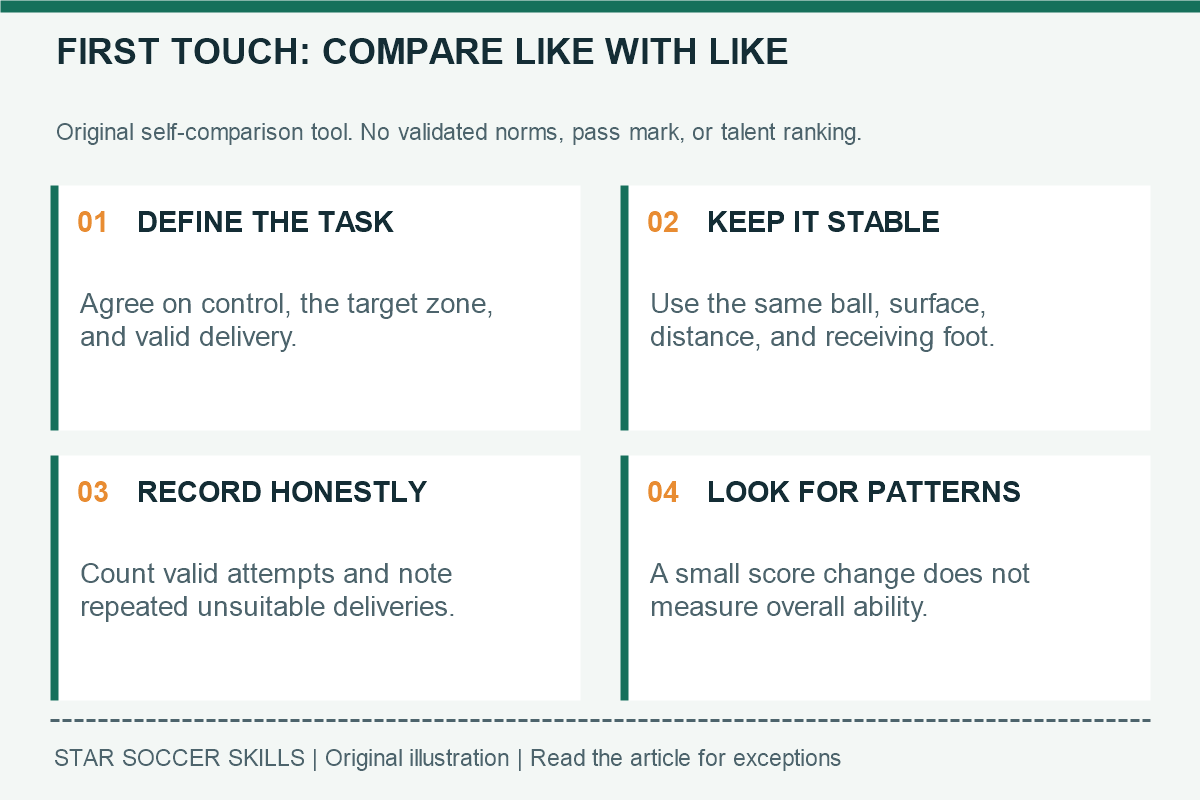
Video: first-touch technique examples
5 Essential First Touch Drills Every Player Should Master by Become Elite is supplementary technique viewing. It does not validate this test or provide a benchmark for your score. Adapt any movement to a safe space and appropriate ability level.
Frequently asked questions
What is a good first-touch score for my age?
This activity has no validated age norms or pass mark. Use it only to compare your own clearly documented setup over time.
Can I use a wall instead of a partner?
A suitable permitted wall can create a separate practice version, but the rebound differs from partner delivery. Label it separately and do not mix the scores.
How often should I repeat it?
Repeat when useful as part of normal comfortable practice, not after every few touches. Allow time to learn between records. There is no required testing schedule here.
General learning context: FIFA Training Centre grassroots resources. The activity, scoring definition, and printable are original self-comparison tools, not an assessment endorsed by FIFA.
Related guides
Continue with these related topics from our beginner soccer library. New guides in this group will become available as they are published.
Leave a Reply