How to Help Your Child Practice Soccer Without Coaching Experience
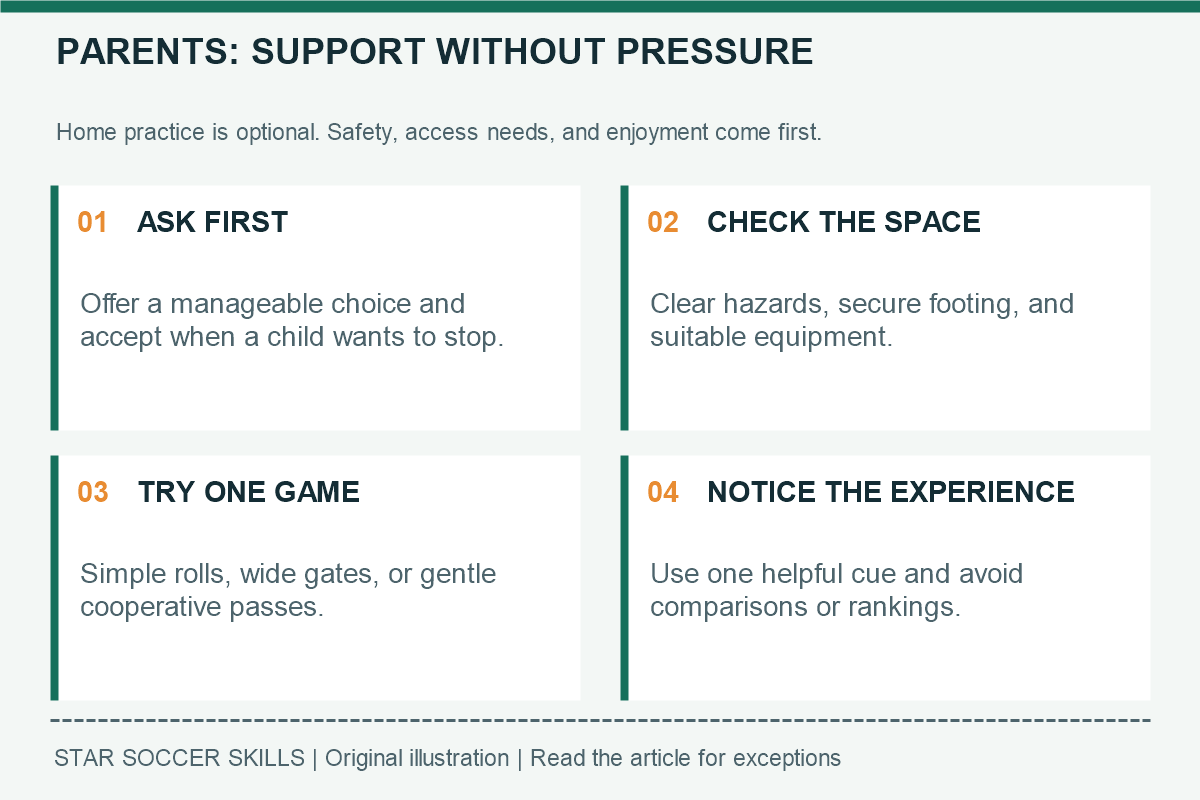
Learning how to help a child practice soccer at home does not require becoming a coach overnight. Your most useful jobs are to provide a safe setting, offer a manageable activity, and listen to whether the child wants to continue. A short enjoyable game can be enough.
This guide is for parents and guardians who want a supportive starting point. It is not an individualized training prescription or a promise of faster development. Use our step-by-step soccer lessons as a menu rather than a list a child must complete on a deadline.
Begin with the child’s choice
Ask whether they would like to try a ball game and offer a small choice: gentle dribbling, a passing game, or looking at a lesson together. A reluctant child does not need a lecture about commitment. Watching first, choosing a different day, or doing another activity can be reasonable.
Agree that either of you can stop. Avoid linking the session to team selection, a sibling’s progress, or rewards for a particular score. The aim is a positive opportunity to learn, not proof that the child is taking the sport seriously.
Check the space before choosing the game
Look for a flat, dry surface, suitable footwear, and room beyond the planned route. Keep glass, stairs, traffic, pets, cables, and other people out of the activity area. A space just large enough to hold a ball may not be large enough for a child to regain balance.
Use an age-appropriate ball and safe markers. A soft practice ball can change how contact feels indoors, but it does not guarantee safety or silence. Avoid socks on a smooth floor, loose rugs, hard shots, and rebounds against shared walls.
Stay present and supervise according to the child’s needs. Stop for pain, dizziness, distress, unsafe footing, or an activity that no longer fits the space. If the setting is unsuitable, review a lesson instead of forcing physical practice.
Three simple activities without coaching jargon
1. Stop the rolling ball
In a suitable clear area, gently roll a ball a short distance along the ground. Let the child stop it with a comfortable foot contact, then reset. Begin slowly enough that the child does not need to chase or lunge.
Demonstrate once and use a simple phrase such as “meet it gently.” If stopping a moving ball is difficult, start with the ball still and let the child move it a small distance themselves. Our ball-control lesson offers easy starting movements.
2. Find an open gate
Make one wide gate with safe markers in an open area. Invite the child to dribble through, stop comfortably, and return. Walk rather than race. If the ball escapes, shorten the route or make the gate wider.
Once the activity feels easy, let the child choose another gate location within the safe area. Change only one detail at a time. The dribbling lesson explains how small touches keep the ball available.
3. A cooperative passing game
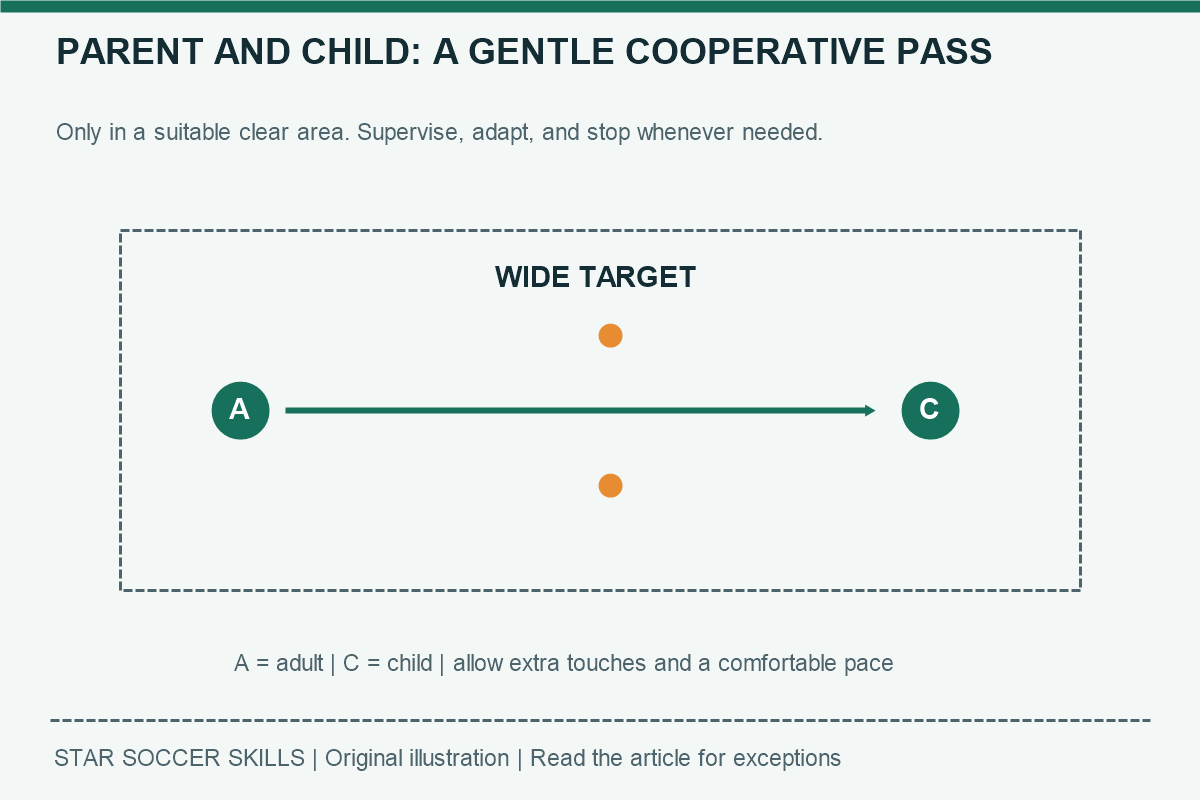
Stand close enough for a gentle ground pass. Send the ball to a comfortable receiving position, let the child control it, and ask for a return when ready. Allow as many touches as needed.
Try a shared aim such as “Can we make a few comfortable passes together?” rather than making the child responsible for a streak. If your own pass is inaccurate, acknowledge it and reset. The passing lesson gives a clear technique reference.
A flexible ten-minute outline
| Time | What to do | Parent’s role |
|---|---|---|
| 0-2 minutes | Choose an activity and check the area | Listen and make the setting safe |
| 2-4 minutes | Try one easy ball game | Offer one simple demonstration |
| 4-5 minutes | Rest and ask whether to continue | Accept a no |
| 5-8 minutes | Repeat or choose a familiar second game | Adjust the challenge rather than demand speed |
| 8-10 minutes | Finish calmly and choose a favorite moment | Notice effort, decisions, or enjoyment |
This is an optional outline, not a recommended minimum or a daily requirement. A child may prefer a shorter activity. Existing team sessions, other play, health, energy, and enjoyment all affect what is appropriate.
Give feedback that helps without taking over
Describe something observable: “You used a gentler touch and kept it close.” That is more useful than “You’re a natural” or “You should be better by now.” Ask what felt different rather than telling the child how every movement should look.
Use one cue at a time. If you have explained several times and the activity still feels difficult, change the setup or return to an easier version. More instructions are not always the solution.
Do not compare siblings or publish practice scores. If a team coach has provided an appropriate focus, keep the home activity compatible with it. You do not need to invent additional homework every time the child plays a match.
Adapt for different needs
Communication, movement mode, ball type, distance, rest, and the way a target is marked can all change. Ask the child what helps and discuss relevant access needs with their club or qualified support professionals through the appropriate channels.
Do not assume the same age means the same task. One child may enjoy directional choices while another needs more time with a stationary ball. The simpler version is not a punishment or a public label.
Video: observe a basic movement first
10 EASY Ball Mastery Exercises For Beginners by 7mlc is a supplementary technique reference. A parent should preview it and choose a suitable movement, not ask a child to copy the full pace or complete every exercise. It is not a required home-training program.
Frequently asked questions
What if I am not good at soccer?
You can still provide a safe area, a gentle roll, encouragement, and a chance for the child to choose. Use a lesson to learn together rather than pretending to know every technique.
How often should my child practice at home?
There is no universal schedule here. Consider the child’s wishes, existing activity, and relevant professional guidance. Home practice should not become pressure to train every day.
Should I correct every mistake?
No. Give time to explore and repeat. Intervene for safety, offer a clear cue when helpful, and make the activity easier if it repeatedly frustrates the child.
General source context: FIFA Training Centre grassroots resources and England Football youth participation information. The activities and routine above are original adaptable suggestions.
Related guides
Continue with these related topics from our beginner soccer library. New guides in this group will become available as they are published.
Leave a Reply