Small-Space Soccer Dribbling Drills for Beginners
Soccer dribbling drills for small spaces should teach you to keep the ball available for the next touch. The goal is not to sprint around a cramped room. It is to change direction, use both feet, and look toward open space while staying balanced.
These beginner activities use a small square and flat markers. They extend our dribbling lesson with layouts you can adapt to a safe home practice area. A suggested 3-by-3-yard square is useful, but the available safety clearance matters more than an exact measurement.
What counts as enough space?
You need room for the planned movement plus a clear margin beyond it. If you cannot turn without approaching furniture, glass, stairs, other people, or a hard obstacle, choose stationary control work or a different location. A smaller playing area is not automatically a safe indoor area.
Use a flat, dry surface, suitable footwear, and an age-appropriate ball. Children need suitable adult supervision. Markers should be flat and non-slip; avoid upright household items that could trip someone. Stop if anything hurts or your footing becomes uncertain.
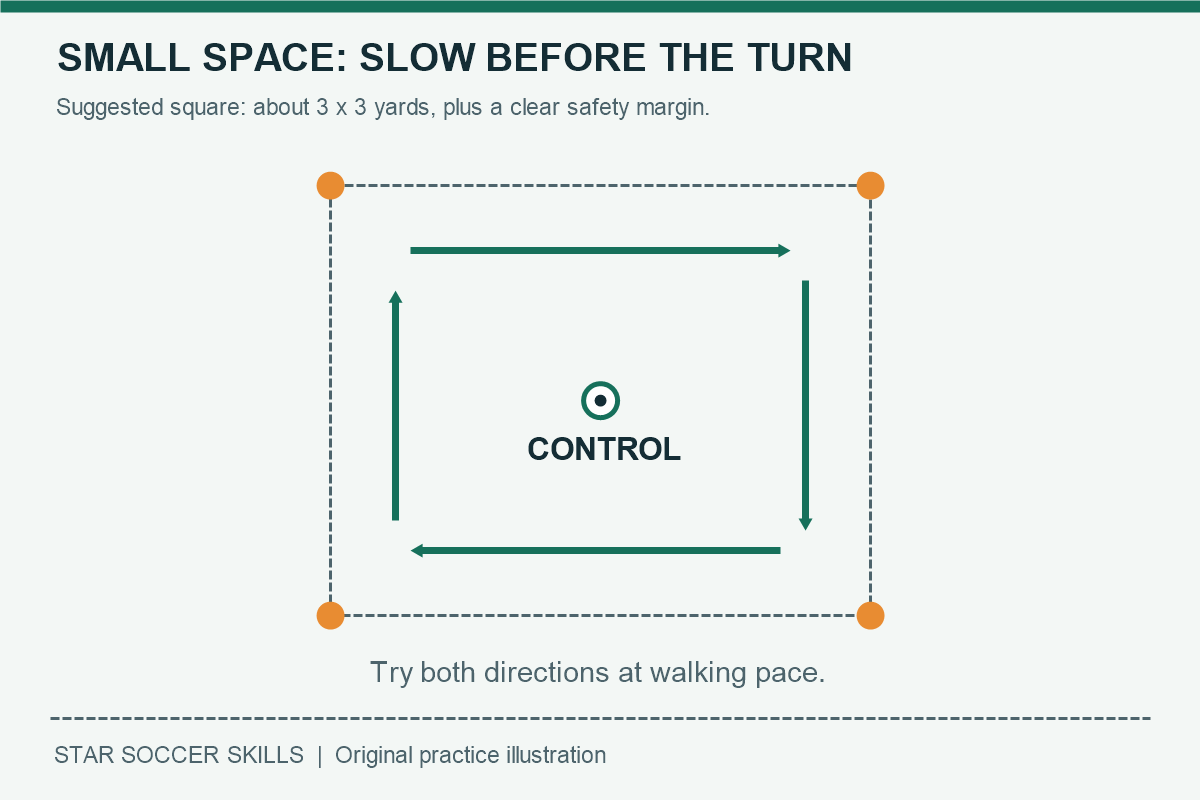
Four small-space dribbling drills
| Drill | Setup | Beginner focus |
|---|---|---|
| Square walk | Four flat corner markers | Small touches before each corner |
| Inside-outside lane | A short clear route between two markers | Different foot surfaces |
| Stop, turn, return | Two turning points | Balanced changes of direction |
| Choose a gate | Two wide exit gates | Look up and choose space |
1. Square walk
Walk around the inside of your square with the ball within one comfortable step. Before each corner, reduce your pace and guide the ball around with several small touches. Stop and reset if it crosses the boundary; do not chase it into an unsafe area.
Complete one comfortable lap in each direction. Going the other way helps you notice whether you rely on the same foot at every turn. Let both feet contribute without forcing an unfamiliar touch at speed.
Make it easier: practice just one side and one turn. Progression: change direction at a corner you choose in advance. Use the cue “small before the turn” instead of trying to race around the square.
2. Inside-outside lane
Choose two markers a few walking steps apart. With one foot, gently move the ball across your path using its inside, then guide it back with its outside. Travel slowly toward the second marker, stop, and walk back to reset.
Try the other foot on the next attempt. Keep the movement modest so you do not overreach or cross your legs awkwardly. If two surfaces at once feel difficult, use inside-foot touches first and add outside-foot touches separately.
Make it easier: practice the two contacts almost on the spot. Progression: use a slightly less predictable route while keeping the same controlled speed. Our ball-control lesson is a helpful starting point.
3. Stop, turn, return
Dribble to a turning marker and stop before it. Gently bring the ball back with the sole or guide it around with the inside of the foot, turn your body, and travel toward the starting marker. Keep your supporting foot on the ground and do not stand on the ball.
Pause between attempts. Start with one reliable turn rather than copying several tricks. When the movement is comfortable, try the same turn using the other foot. The turning lesson explains how to change direction into useful space.
Make it easier: begin from a stationary ball. Progression: remove the complete stop before the turn, provided the ball still stays close and your footing is secure.
4. Choose a gate
Make two wide gates along different sides of the square. Begin near the center with gentle touches, glance toward one gate, and guide the ball through it. Stop in the clear area beyond, then reset. If there is no safe run-off space, approach the gate and stop before it instead.
Choose your destination before moving. Later, a supervising adult or partner can name a gate early enough to let you react calmly. Do not close your eyes or turn away from hazards to make the task harder.
Make it easier: use only one gate. Progression: change the chosen gate before you start the approach. This introduces a simple decision, but it does not replace playing against a defender.
A short practice session with breaks
Use two minutes for easy movement and touches, two minutes each for the first two drills, then a one-minute break. Spend two minutes on turning and two minutes on gate choice, then take one minute to finish and record a note. That makes a 12-minute outline. Shorten it whenever attention, balance, or enjoyment drops.
Video: observe close-control footwork
7mlc’s Easy 10 Minute Ball Mastery Workout offers an external view of close-control movements. It is a separate workout, not an instruction to complete every movement in a cramped space. Watch the technique, select a suitable activity, and practice more slowly when needed.
Fix these common small-space mistakes
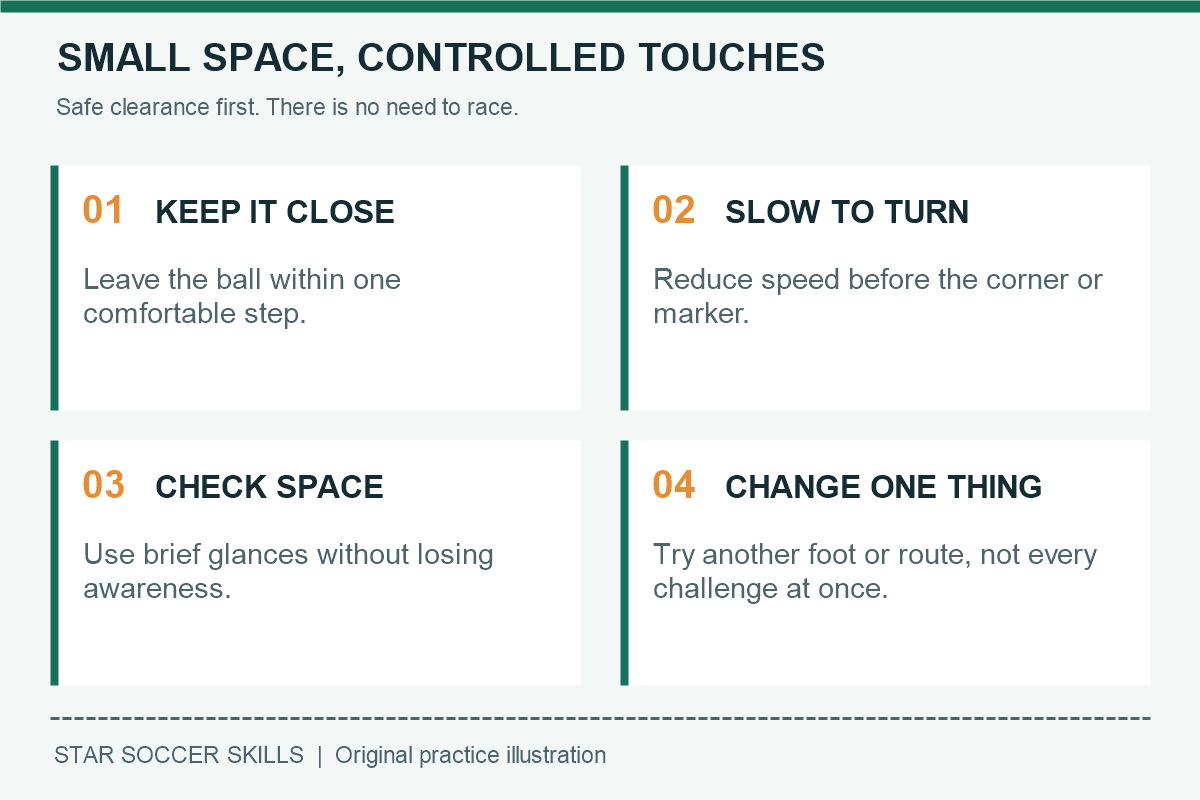
- Touching too far ahead: reduce the force until the next touch is comfortable.
- Looking up for too long: use brief checks of your space while continuing to monitor the ball and surface.
- Leaning into every turn: slow down, reset your feet, and regain balance before moving again.
- Making the square smaller too soon: smaller is a challenge, not automatically better practice.
- Ignoring the other foot: give it easier repetitions rather than abandoning it or forcing speed.
Measure a clean attempt
Choose one route and make five attempts at walking pace. Record how many you finish without leaving the boundary, hitting a marker, or needing a lunge. Keep your setup the same when you repeat the exercise. A clean attempt is your own practice definition, not an official skill rating.
Once the route feels consistently comfortable, change one thing: foot, route, or a simple early cue. Do not simultaneously shrink the area and increase speed. Bring the technique into a suitable small-sided game when you can practice with others.
Frequently asked questions
Can I practice in a bedroom?
Only if there is genuinely enough clear, safe space and the surface is suitable. A room with furniture close to your turning route is not appropriate. Stationary gentle control may be a better option, or move to another location.
Do I need cones?
No. Flat non-slip markers or existing ground markings can define a route. Do not use glass bottles, rolling objects, or anything you might trip over.
Will small-space drills make me better at beating defenders?
They can help you practice control and direction changes, but opponents add timing, pressure, and decisions. Combine technique work with age-appropriate game practice rather than expecting a solo drill to do everything.
Explore the full beginner course for connected lessons. General coaching context: FIFA Training Centre grassroots resources. The layouts and session timings here are original adaptable suggestions.
[…] Small-Space Soccer Dribbling Drills for Beginners […]