Quiet Indoor Soccer Drills for Small Homes
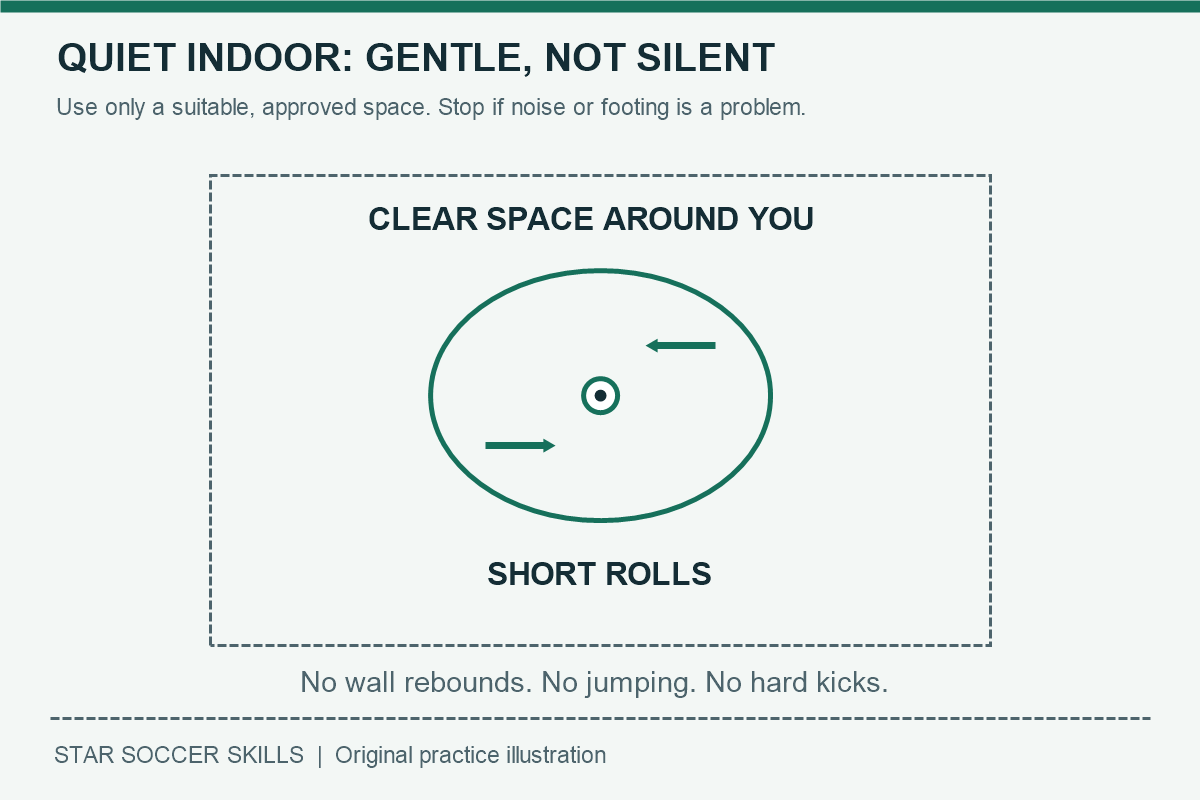
Quiet indoor soccer drills are best treated as low-impact ball-control practice, not a way to play a full game inside. Slow rolls and gentle touches may reduce impact noise compared with bouncing, kicking, or jumping, but no exercise can guarantee silence in every home.
This guide focuses on small, controlled movements for beginners. Building rules, flooring, neighbors, supervision, and the space available come first. Use our ball-control lesson to learn the basic touches, then select only the indoor activities your setting can safely accommodate.
First decide whether indoor practice is appropriate
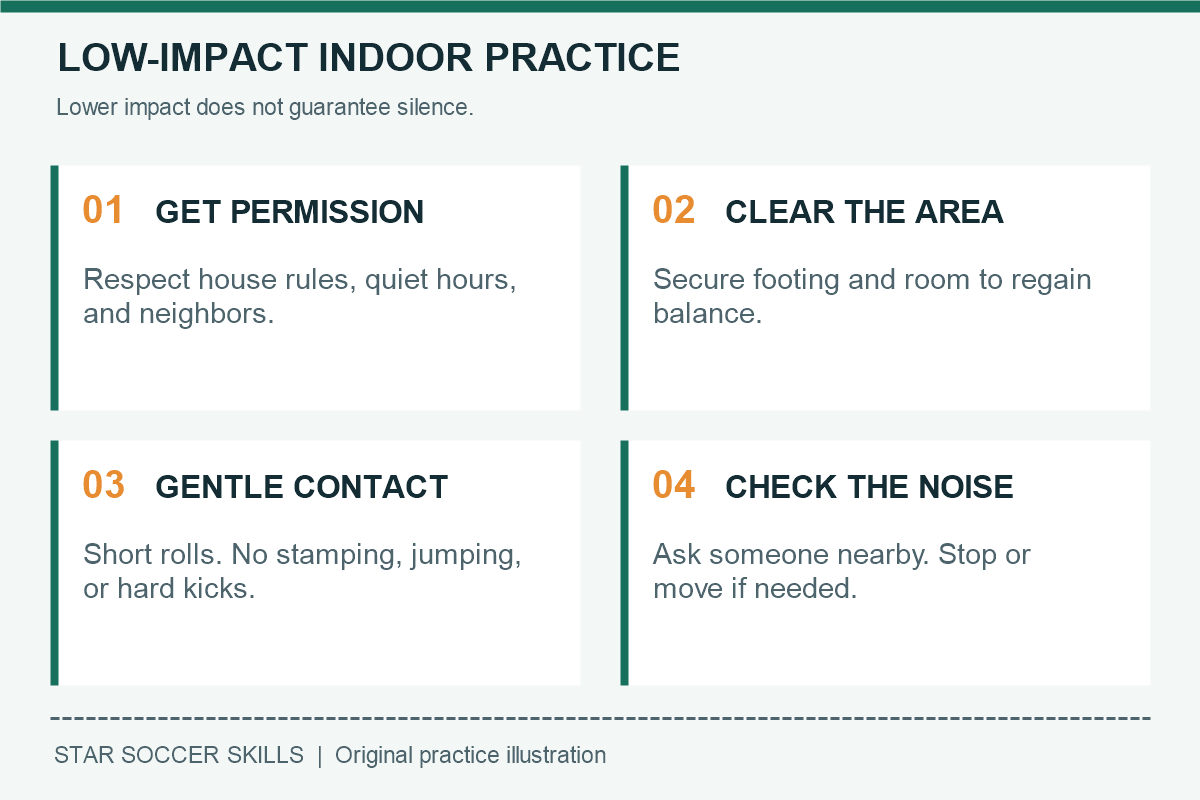
Choose a clear, dry, non-slip area away from stairs, glass, sharp furniture edges, cables, pets, and other people. You need room to step and regain balance, not just enough floor space for a ball. A crowded bedroom or narrow hallway may be unsuitable.
Ask permission to use the space and respect quiet hours. Wear footwear that suits the surface; socks on a smooth floor can slip. Children need appropriate adult supervision. Stop if anything hurts, if the surface moves, or if you cannot keep the ball in the safe area.
A soft practice ball may reduce some impacts and the risk of damage compared with a hard match ball, but it can still make noise, mark surfaces, or roll underfoot. Its behavior will differ from a regular ball. Do not reduce a ball below its recommended pressure just to make it quieter.
| Activity | Possible indoor option | Avoid |
|---|---|---|
| Ball control | Slow rolls and gentle inside-foot touches | Stamping or standing on the ball |
| Passing | Skip it unless there is a suitable approved area | Rebounds against shared walls or furniture |
| Footwork | Comfortable steps with both feet near the floor | Jumping, hopping, or sharp cuts on uncertain footing |
| Surface | A stable surface that stays dry and secure | Loose rugs, sliding mats, or socks on smooth flooring |
Four low-impact ball-control activities
1. Gentle sole roll
Start with the ball still. With most of your weight on the supporting leg, place the other foot lightly on top and roll the ball a short distance sideways. Put the foot back on the ground and stop the ball gently. Repeat in the other direction.
There should be no stamping, jumping, or balancing on the ball. Begin with a handful of slow attempts, pause, and check the sound and surface. If it is noisy or unstable, stop instead of trying to force a quieter version.
Easier: use a very short roll and the same foot to stop. Progression: alternate the rolling foot while keeping the same gentle pace.
2. Slow inside-foot exchanges
Stand comfortably with the ball between your feet. Nudge it with the inside of one foot, let it travel a small distance, and return it with the other. Keep both feet close to the floor and pause after a few touches.
The aim is control without a pounding rhythm. You do not need to copy a fast online workout. If the ball keeps reaching the boundary, reduce touch strength or return to one touch followed by a complete stop.
Easier: stop between every contact. Progression: connect several gentle exchanges without raising the pace. The beginner ball-control exercises provide more technique detail.
3. Self-roll and cushion
From a stationary position, gently roll the ball a short distance forward with your foot, then take a comfortable step and cushion it with the inside of the other foot. Reset rather than chasing it across the room. Keep every movement inside your clear area.
This is a preparation exercise for controlled contact. It does not replace receiving a pass from another player. When you have a suitable outdoor area and a partner, use our first-touch lesson to add realistic incoming passes.
Easier: shorten the roll. Progression: guide the gentle first touch toward a chosen side, without adding force.
4. Small V-pull
Only try this if sole rolls feel comfortable and the surface is secure. Start with the ball slightly ahead of one foot. Pull it gently back with the sole, then use the inside of that foot to guide it diagonally forward a short distance, making a small V-shaped route.
Pause and reset after each attempt. Keep your supporting foot stable and the ball within easy reach. If the sequence makes you hop or lose balance, return to simple rolls. Our turning lesson offers broader direction-change practice for a suitable setting.
Try a 10-minute low-impact routine
Begin with two minutes of easy movement and a check of the area. Spend one minute each on gentle rolls and slow inside-foot exchanges, then rest for one minute. Use one minute for self-rolls and one minute for small V-pulls, or repeat an easier activity. Finish with one minute of rest, one minute of your most comfortable drill, and one minute recording a note. That totals ten minutes, including breaks.
These are suggested blocks, not continuous-work requirements. Shorten them for attention, comfort, and supervision needs. If indoor practice is unsuitable, use the time to review a lesson and choose a safe outdoor session instead.
Video: observe technique, then slow it down
7mlc’s 10 EASY Ball Mastery Exercises For Beginners demonstrates ball-control movements. It is not a noise-tested indoor routine. Use it only as a technique reference, and skip bouncing, rapid footwork, or any movement unsuitable for your home.
Check noise rather than guessing
If possible, ask another household member to listen from an adjacent room while you try a few gentle movements. Sound travels differently through walls and floors, and what seems quiet beside the ball may still disturb someone below. Respect feedback and stop or move the activity if needed.
Do not promise a particular noise level based on a phone recording or the type of ball alone. A mat is not a universal fix: if it slides, folds, or catches your foot, it introduces a new hazard.
Frequently asked questions
Can soccer practice be completely silent?
No universal guarantee is possible. Footsteps, contact with the ball, and building construction all affect what others hear. Low-impact practice may be quieter than jumping or wall passing, but permission and a real noise check still matter.
Is carpet always safer?
No. Carpet changes how the ball moves and may catch footwear; loose rugs can slide. Check the actual surface and choose a different location if it does not allow comfortable, secure movement.
Should I practice shooting indoors?
Not as part of this routine. Shooting and hard passing require a purpose-built or otherwise suitable approved space. Keep this session focused on gentle control.
Continue with the step-by-step learning path when you want a wider skill plan. For general coaching context, see FIFA Training Centre grassroots resources. This article’s indoor adaptations are original suggestions, not an acoustic assessment or individualized training advice.
Related home practice guides
- Small-Space Soccer Dribbling Drills for Beginners
- Soccer Drills at Home Alone: A Beginner Practice Routine
[…] dribbling drills for small spaces should teach you to keep the ball available for the next touch. The goal is not to sprint […]