Printable Soccer Practice Progress Tracker for Beginners
A soccer practice progress tracker is most useful when it helps you decide what to practice next. It does not need to rank players, predict selection, or turn every session into a test. Record a small amount of repeatable information and one useful observation.
The printable below is an original beginner self-record, not a validated assessment. It works alongside our step-by-step soccer lessons. Choose a suitable activity from the course, describe the setup, and compare only sessions that genuinely used similar conditions.
Download the printable tracker
Download the printable soccer practice progress tracker (PDF). It contains a setup section, blank session rows, a reflection area, and a reminder that results are for personal comparison. Print extra copies when you need more space; no account or email is required.
Use a nickname or initials if the sheet will be carried to a group session. There is no need to record a child’s full date of birth, address, school, or other identifying details. Keep individual notes private rather than posting score sheets online.
Choose one skill and one repeatable task
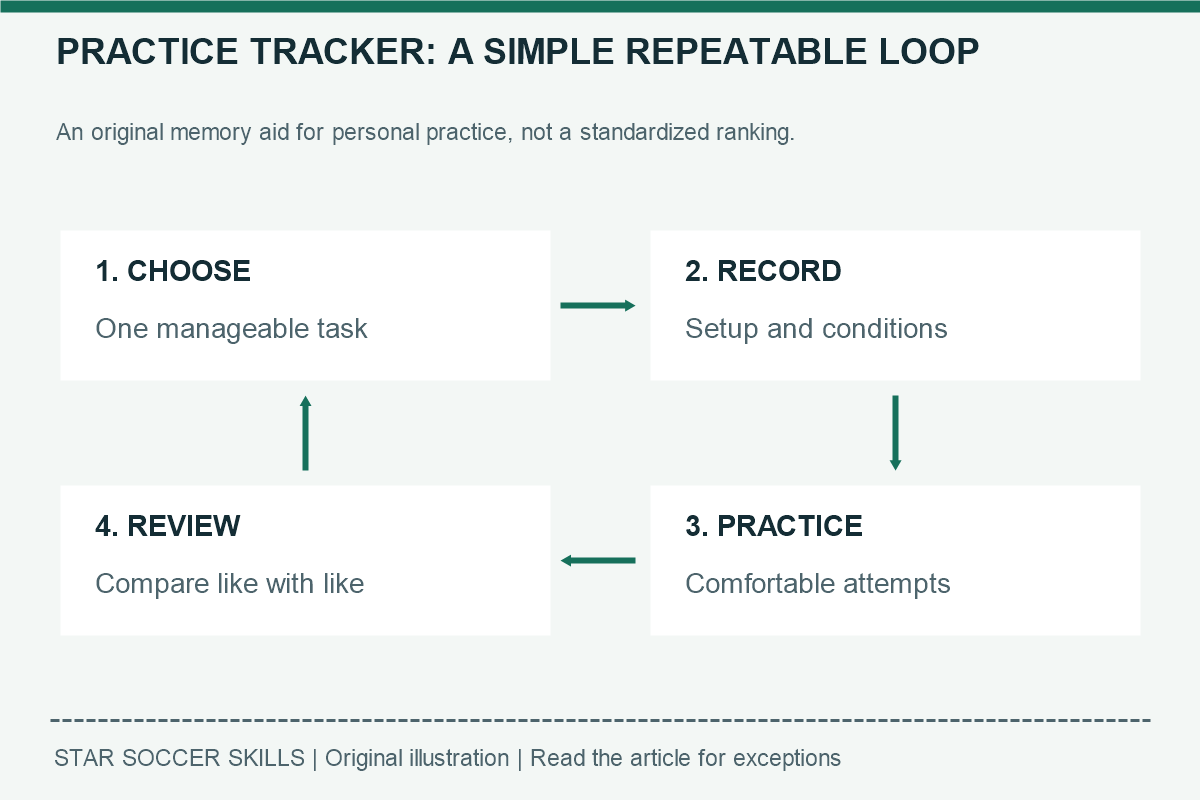
Pick a task simple enough to describe in a sentence. For passing, you might use ten gentle ground passes through a wide gate at a fixed distance. For control, you might record whether a short route finishes with the ball within comfortable reach.
Do not add a different scoring rule each time. Write down what counts as a controlled attempt before the first record. A target that becomes narrower creates a new task, even if the activity has the same name.
Our passing lesson, dribbling lesson, and first-touch lesson offer activities you can simplify. Use a safe surface, suitable ball and footwear, and appropriate supervision for children.
What belongs on a useful practice record?
| Field | Example of what to write | Why it matters |
|---|---|---|
| Setup label | Ground passing, wide gate, version A | Separates different tasks |
| Equipment and surface | Same ball and dry practice surface | Changes affect the ball’s behavior |
| Distance or area | Measured passing distance and gate width | Keeps the challenge comparable |
| Foot and attempts | Right foot, ten valid attempts | Avoids mixing different sets |
| Result | Controlled attempts out of valid attempts | Records the denominator, not only a total |
| Observation | A softer first touch helped the return pass | Connects a number to a practical idea |
| Next step | Repeat the same setup before changing it | Prevents automatic escalation |
How to make your first entry
- Check that the practice area is clear, dry, and suitable for the movement.
- Choose an activity and write a short setup description.
- Try a few comfortable familiarization attempts before recording.
- Record a manageable set, allowing breaks as needed.
- Write one observation and one possible next step.
Stop for pain, dizziness, distress, fatigue that affects control, or an unsafe surface. A blank row or a note saying “stopped early” is a valid record. Completing the sheet is never more important than the player.
A younger child may prefer drawing a symbol or choosing a favorite activity rather than counting attempts. A parent can record the setup without turning the session into an examination. Keep the process proportionate to the player’s interest and needs.
Understand a result without inventing a benchmark
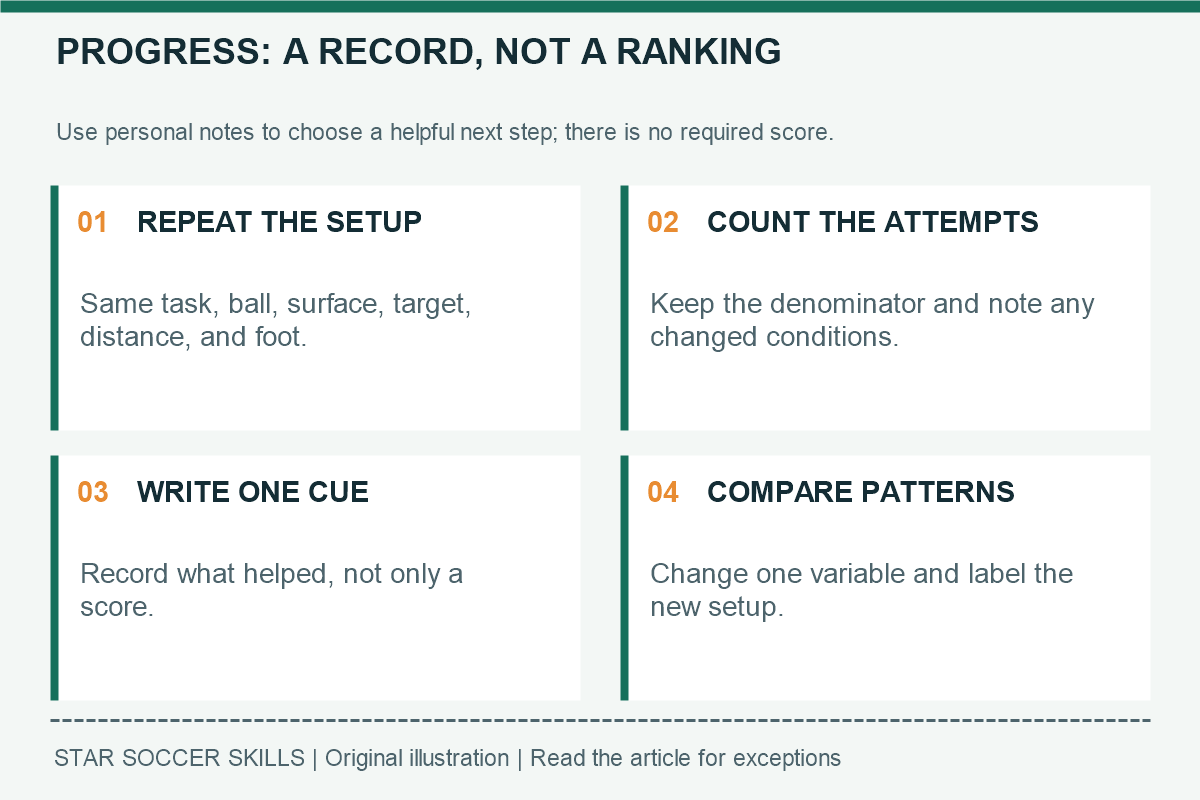
Imagine a practice entry says “six controlled passes out of ten” and the next comparable entry says “seven out of ten.” Record it as a small change in that task, not proof that overall soccer ability improved by a precise percentage.
Pass delivery, attention, surface, and normal day-to-day variation can affect the result. A repeated pattern plus a useful technique observation is more informative than one unusually high score. Do not compare it with another player’s record from an unknown setup.
The tracker has no age norms, selection thresholds, or required weekly improvement. It is a memory aid for practice, not a standardized test. If you change the foot, area, target, or pressure, label the change rather than blending the numbers.
Review the notes without adding pressure
After several comparable sessions, ask: What felt more comfortable? Which cue helped? Is the activity still enjoyable? Would repeating the same version be useful, or is one small progression appropriate?
A progression could be a different receiving angle, another foot, or a simple early cue. Change one variable at a time and establish a fresh baseline. More difficulty is not automatically better, and a lower result on a new task does not mean the player has gone backward.
Also notice what a solo tracker cannot capture: supporting a teammate, reading an opponent, reacting after losing possession, and cooperating in a game. Use our small-sided games lesson to connect technique with decisions.
Video: choose a manageable control activity
Easy 10 Minute Ball Mastery Workout by 7mlc is a supplementary technique reference. You do not need to complete the workout to use the tracker. Choose only a suitable familiar movement, and do not treat the video’s pace as a score target.
Frequently asked questions
Should I record every practice?
No. Use the sheet when it helps. Enjoyable unrecorded play is still valuable, and the tracker should not create a requirement to train or test daily.
Can a coach use it with a group?
Yes, as a simple individual record with appropriate privacy and explanation. Do not present the original scoring choices as a validated ranking or publicly compare children.
What if my score stays the same?
Look at comfort, consistency, and the notes, not just the total. Ask a suitable coach for help if useful. There is no promised rate of improvement from this sheet.
General learning context: FIFA Training Centre grassroots resources. This tracker and its examples are original personal-practice tools, not an endorsed talent-identification system.
Related guides
Continue with these related topics from our beginner soccer library. New guides in this group will become available as they are published.
Leave a Reply