U10 Soccer Practice Plan: Skills and Small-Sided Games
A U10 soccer practice plan can connect ball control, passing, and decision-making without becoming a complicated tactical lecture. Give players a clear problem to solve, let them play, and use brief coaching moments to help them notice a useful option.
This original 45-minute plan focuses on receiving, offering support, and changing from attack to defense. It includes rest and transitions. U10 eligibility depends on local age cutoffs, and players will differ in experience and access needs. Treat the schedule as an adaptable starting point, not an official age-group standard.
One session theme: receive, look, and support
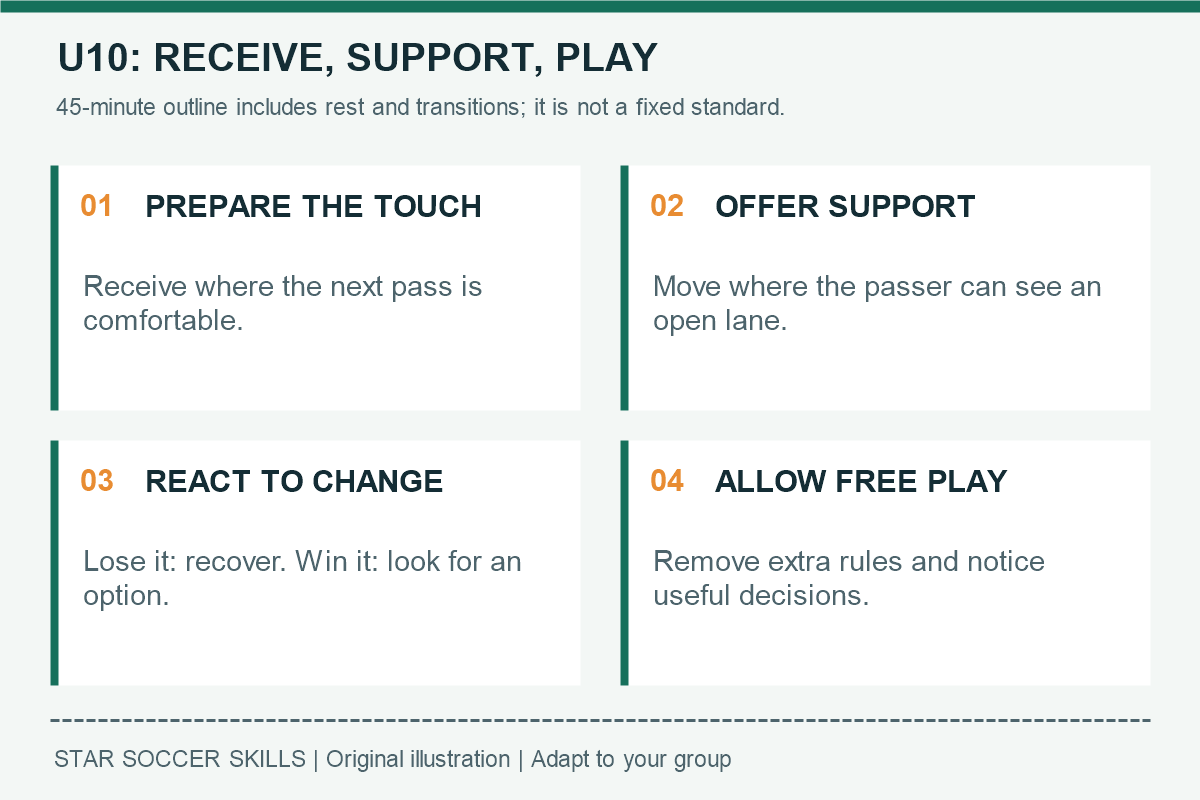
Introduce the theme with a short question: “Where could you move so your teammate can pass to you?” Then demonstrate a useful receiving angle. Avoid trying to teach formations, finishing, pressing, and several passing techniques in the same session.
Read our positioning and tactics lesson beforehand for simple explanations of width, support, and transition. Players do not need to memorize those labels before they can explore the ideas.
Set up safely and keep the group involved
Follow club requirements for safeguarding, supervision, protective equipment, first aid, weather, and player handover. Check the surface, allow clear run-off space, use age-appropriate balls, and secure any goals according to the venue and manufacturer’s requirements. No child should climb or hang on a goal.
The example suits roughly eight players. With a different group, adjust numbers and create supervised parallel games rather than long queues. Children can rest or take water when needed. Stop for pain, dizziness, distress, unsafe challenges, or unsuitable conditions. This session does not include heading or slide tackles.
Have markers and bibs ready so setup changes are brief and supervised. Share adaptations through your club’s normal process with players and guardians. A child’s age label should never override their comfort, ability, or need for a simpler task.
The 45-minute U10 session plan
| Time | Activity | Learning focus |
|---|---|---|
| 0-5 minutes | Easy movement and paired ground passes | Comfortable control and readiness |
| 5-13 minutes | Receive, pass, and change angle | First touch prepares the next pass |
| 13-15 minutes | Water and setup change | Rest and explain one new task |
| 15-23 minutes | 3v1 support game, with short role rotations | Offer a visible passing lane |
| 23-25 minutes | Water and a brief question | Notice what created space |
| 25-35 minutes | Small-sided end-zone game, with pauses | Use support and react after a turnover |
| 35-37 minutes | Rest and reset | Remove extra conditions |
| 37-43 minutes | Free small-sided play | Try the ideas with less coach direction |
| 43-45 minutes | Easy finish and reflection | Choose one useful takeaway |
Activity 1: receive, pass, and change angle
Begin in pairs about 4-6 yards apart, shortening the distance until both players can send a comfortable ground pass. Give each player two nearby receiving positions, marked with flat markers. Keep each pair’s lane separate from the next.
Player A passes to Player B, then moves at a controlled pace to the other receiving position. Player B takes a first touch into a useful position, looks up, and passes to A’s new location. Swap the moving player’s role after several repetitions.
Start without a touch limit. Two touches may become a useful option, but do not require it when players need more time. Our passing lesson and first-touch lesson explain the technique.
Make it easier: keep one player stationary and reduce pass speed. Progression: let the receiver choose between the two positions before the return. Ask “Can your partner see where you want the ball?” rather than directing every movement.
Activity 2: 3v1 support game
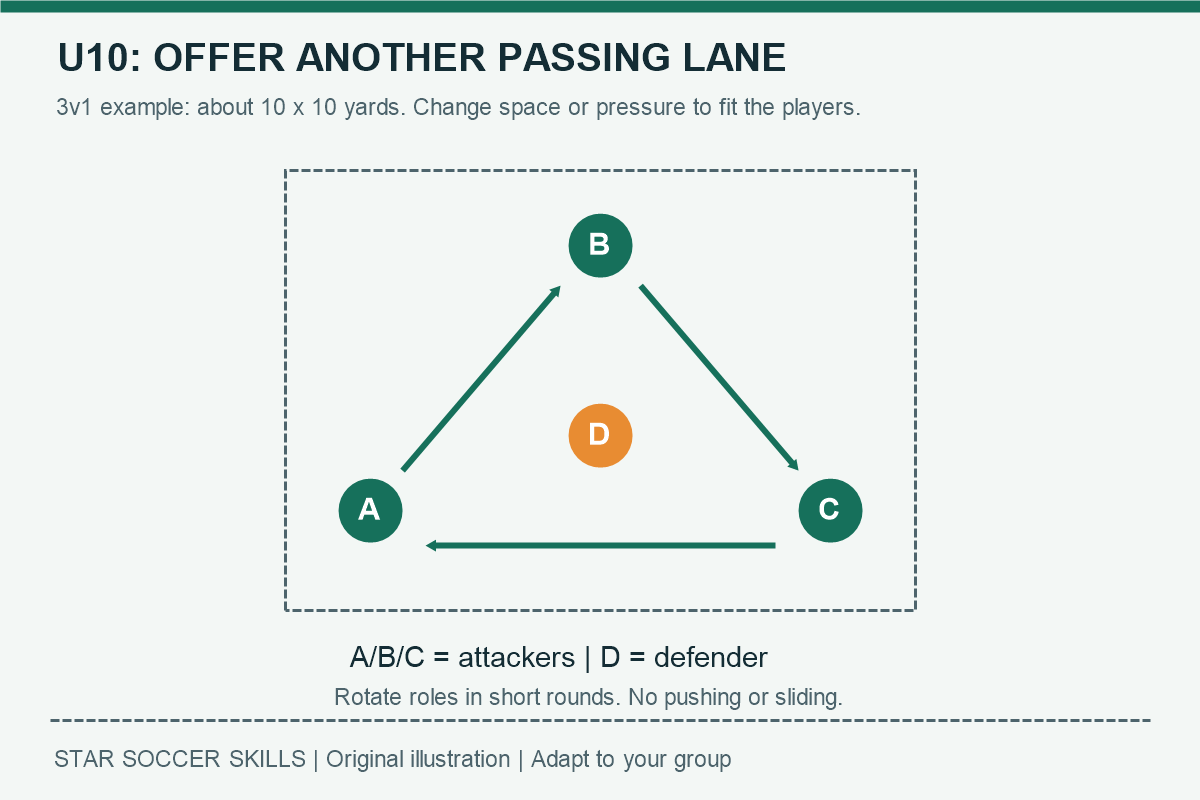
Use three attackers and one defender in a square. Roughly 10 by 10 yards is an initial suggestion; enlarge it if beginners rarely complete a pass, or change the pressure before changing the size. For eight players, use two supervised grids with enough separation.
The attackers try to keep the ball using short ground passes and helpful support positions. The defender tries to intercept; begin with walking or passive pressure if needed. No pushing, grabbing, or sliding. Rotate the defender after short timed rounds so a child is not left chasing repeatedly.
Do not make “the player who loses it becomes defender” the only rotation method. A planned rotation gives everyone a turn and avoids repeatedly singling out a beginner. If an interception occurs, reset calmly or let the coach restart.
Make it easier: remove the defender briefly, or restrict them to blocking one lane. Progression: allow controlled active defending while keeping generous time on the ball. The aim is to find another visible option, not reach a compulsory pass count.
Use the cue “move out of the defender’s shadow.” Our teamwork lesson connects this idea to helping the player with the ball.
Activity 3: small-sided end-zone game
For eight players, try 4v4 on a suitably marked field with a shallow scoring zone at either end. Roughly 24 by 18 yards can be a starting point, with clear margins beyond the field. Adjust if the area creates repeated collisions or leaves players unable to find one another with manageable passes.
A team scores by completing a controlled ground pass to a teammate moving into its attacking end zone. The receiver should stay in the safe area and have room to control. If passing into the zone is too difficult, temporarily allow a controlled dribble entry instead.
When possession changes, encourage the team that lost the ball to recover between the ball and its own scoring zone. The team that wins it looks for a useful first pass or clear space. Avoid shouting a full tactical sequence during every turnover.
These are training conditions, not claims about official U10 match laws. Explain your practice restarts and check local rules separately. Rotate roles naturally rather than keeping children in fixed positions. Use the basic defending lesson for safe positioning cues.
Finish with fewer conditions
After a break, let players play a short small-sided game with a simple agreed scoring method. Remove the special passing condition and watch whether players still offer support or prepare a pass with their first touch. Intervene for safety, but resist stopping every imperfect decision.
Ask one question afterward: “What helped you receive the ball?” Accept different useful answers, such as moving into view, using a softer touch, or communicating. Finish with encouragement that describes an action rather than labeling a child as talented or untalented.
Video: receiving and movement in a coaching session
Pass And Move by England Football Learning, with Ryan Davies, is an external coaching demonstration. Preview it before selecting ideas. It is not the exact U10 session above or a requirement to use the same pace, group size, or setup.
Frequently asked questions
Should I enforce two-touch soccer?
Not automatically. Start with enough time for a useful action. A touch limit can change the challenge later, but it can also rush beginners and remove chances to dribble into open space.
What if the 3v1 activity is too hard?
Reduce pressure, enlarge the grid, or return to three attackers without a defender. Change one variable, observe, and adapt again rather than blaming players for losing possession.
Is 45 minutes required for U10?
No. Follow club guidance and player needs. The outline includes breaks; shorten activities or the entire session when appropriate. Weather, other training, and individual needs can change what is suitable.
Continue with our small-sided games lesson and complete beginner course. General source context: FIFA Training Centre grassroots resources. This plan is original and adaptable, not individualized training advice or a federation-prescribed curriculum.
Related youth practice plans
- U8 Soccer Drills: Simple Games for Ball Control and Passing
- U6 Soccer Practice Plan for First-Time Coaches
Optional home practice guides
For a suitable home setting with guardian permission and supervision, these related guides offer additional activities. They are optional, not homework requirements.
Leave a Reply